Since our return from the C2C, many people considering adventure expeditions have asked us about the success of our packing and planning. Although for the purposes of this article ‘one’ fits within the definition of ‘many’ and ‘blankly staring cat’ fits within the definition of ‘people considering adventure expeditions’.
Did all that thought, development of lists, and internet and retail shopping result in a smooth journey where the right riding gear, clothes, hats, toiletries, pharmaceuticals, and equipment were always to hand? Or did we find ourselves like the bloke in 127 hours but without a Swiss Army knife with the bone sawing tool? The number of writers who have covered the topic of what to take is very large, and many items that made it into our luggage can trace their inclusion to these practiced souls, particularly Brian and Shirley Rix of self-managed touring fame for everywhere except Africa.
Finding out how to prepare the most important thing, the motorcycle, can be a little more difficult. The first question to ask is – did I purchase (or borrow from a mate to “ride down to the shops” if you are an adventure riding sociopath) a bike with an “A” letter at the end, as in GSA or XCA, or “Adventure” for those with limited crossword skills, as in KTM 1190 Adventure – or am I planning to ride an A-less or base model bike? A-less basically means more internet shopping time, or more trips to the shops if you live urbanely, and weekends spent opening bubble wrapped packages and going to Bunnings to get more cable ties to fit whatever you have bought to the bike.
Protection is something we are told about from puberty, and on an expedition there will be moments of incredible temptation to ride places your mother or vicar warned you about. Whether a lack of protection causes tertiary syphilis, or a cracked sump on the side of a dirt road in Ethiopia, the result will be the same – madness. Or a ride in the support vehicle for the rest of the trip, there probably are a few more realistic options than just madness. Key protection items we considered to be the minimum and made sure we had fitted were Barkbusters, sump guards, engine guards, headlight guards, and radiator guards. Just ask the C2C New Yorkers Craig and Kathy about not having radiator guards and the propensity for dual sport motorcycle tyres to pick up rocks and chuck them at someone following behind’s radiator. And to believe you are not going to have your bike fall over at least once is optimism of the most disturbing kind, so Barkbusters and engine guards will prevent breaking levers or damaging important bits of the engine.
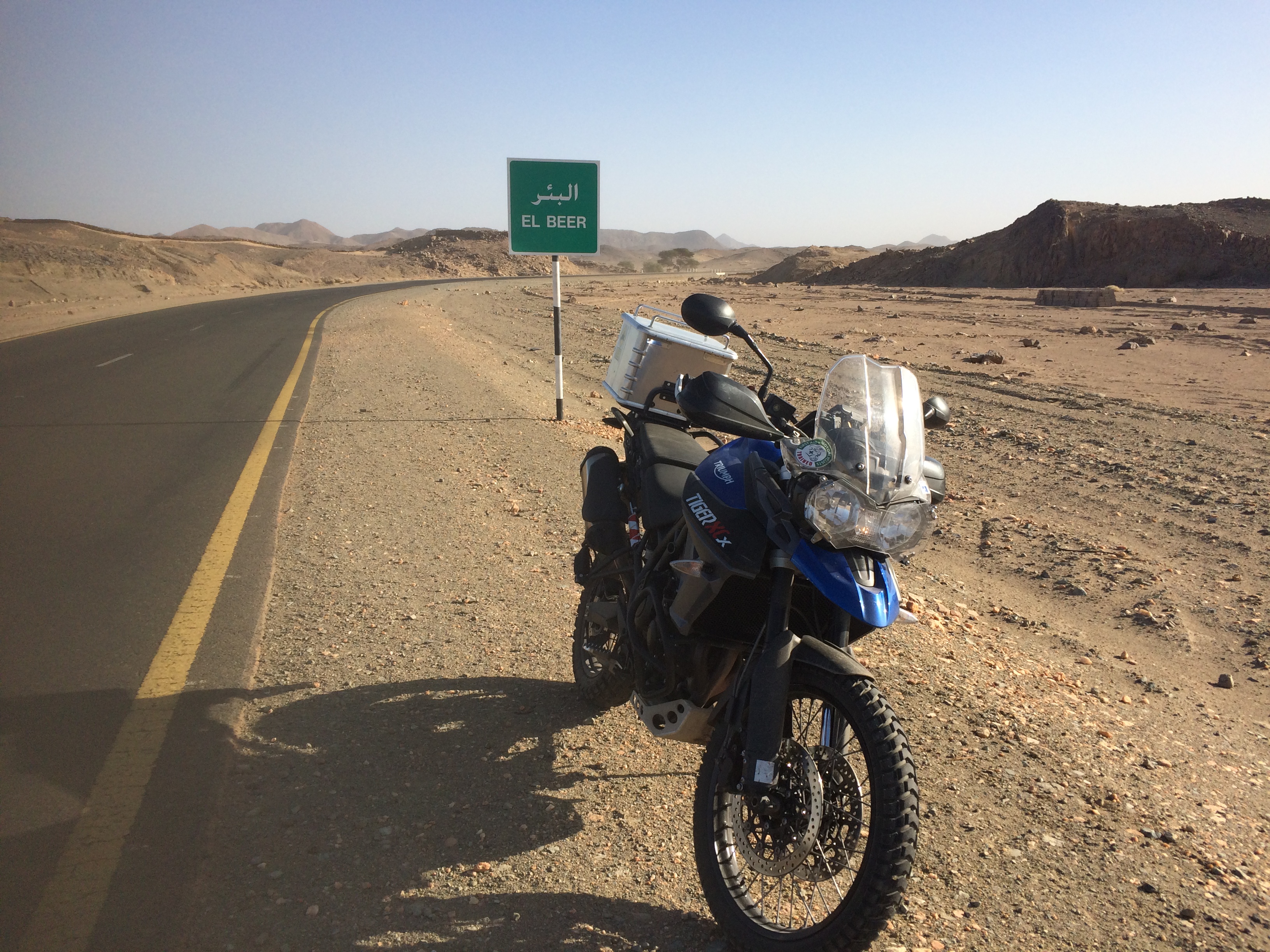
Compass Expeditions were clear on the spares. There will unlikely be any spares for BMW, Triumph, KTM, or even Honda, Yamaha, or Suzuki in the adventure touring range of bikes until Johannesburg, and the tour doesn’t go anywhere near there. Swakopmund in Namibia is possibly the only hope, and the show is nearly over by then. Light bulbs are just about the only hope for African on-tour purchase. Stuff for a basic service, including oil filter, and sump plug and washer, were obvious parts of the inventory, and all that we actually used. Cindy’s chain was growing faster than bamboo by the end, and mine with 30,000km on at the start was nearly as bad. So if we’d needed to ride another 1,000km it would have been a sprockets and chain job on both, and we had them as spares. Brake pad spares are useful, however an 18,000km trip is unlikely to wear a new set down, so starting fresh should mean the spare set can wait until you are home. Same with the spark plugs, essential to have new ones in case of disaster, but unlikely to be required for normal maintenance.
We had a spare air filter each, again sensible in case of disaster or a sub-Saharan bull dust frenzy. These can be a big drama to change and on some bikes require taking the fuel tank off to get at it. A lot of dust was experienced in Sudan and Ethiopia, and the air filter is typically so well hidden you can’t see how dust infected it is. I had put a pre-filter on The Precious, best $25 ever spent. In twenty minutes it was out, taken up to the fifth floor hotel room in Nairobi, washed and rinsed, put into a hotel shower cap with a small amount of engine oil, and put back into the bike. And 10 minutes of that was spent cleaning up the hotel sink so that the staff didn’t think I’d been slaughtering a Minke whale.

“What tools did you take?” I sense the blankly staring cat asking. A dirty great LandCruiser support vehicle is relentlessly following behind like you owe it a lot of money, so surely no tools are necessary. True, but having the basics meant getting a job started or even finished well before a LandCruiser hove into sight, and a support vehicle isn’t set up like a tradie ute so obtaining a 4mm Allen Key may mean dropping everyone’s luggage except your own into mud on the side of the road to get at the toolbox. You’ll obviously place your luggage on the top of someone less important’s, but it is still a nuisance.
So enough tools were taken to get front and back wheels off, undo most of the Allen key panels and bits, and 6mm to 13mm metric bolts and Phillips and standard screws. For my bike at least. Blue Betty is a BMW motorcycle, a brand which used to sell motorcycles standard with enough tools for setting up a workshop and undertaking a total engine rebuild, but now uses every size Torx bolt on the bike except the one that matches the supplied Torx key. So a few Torx keys were included which could be attached to a Bunnings cheapo multi-tool. What did I wish I’d taken? A small pair of vice-grip pliers would have been very handy for locking onto my spokes when trying to undo the broken ones, and could even be pulled into service as a spare gear or rear brake lever in the event of catastrophe. Compass had a hard rubber mallet, which was brought into service to bash out an Ethiopian pothole-inspired dent in the front rim, but I wouldn’t bother taking one as the same can apparently be done with a stone-age plank and rock combination.
Having all these spares and tools is wonderful, and brings on daydreams of being recognised by Dakar winner Toby Price at an Adventure Motorcyclist of the Year event who says “you’re that bloke who rebuilt your gearbox in Kenya with 8 gauge wire, can I have your autograph?”. Then you need to replace an indicator globe and spend 4½ hours taking bolts out and trying to figure out how to get the fairing off, before giving up and selling the motorcycle. Fortunately, everything from neurosurgery to building a three stage rocket for a Mars expedition is on YouTube these days, so taking links to relevant YouTube videos makes maintenance life very easy. Copies of basic motorcycle manuals are freely available on-line, so having them in eBooks on the iPhone meant that the Toby Price daydreams were back with a vengeance. A bit of practice before departure was also much appreciated.
Tyre levers taken were home-made and based on a set I’d previously used. But just because you once successfully walked up Mt Kosciusko doesn’t mean the same jacket will do well on Everest, and so the tyre irons that could get the rear off a 1989 Honda XR250 proved to be very close to utterly useless on an adventure motorcycle rear. I’m buying a set of Motion Pro Beadpro tyre irons as soon as The Precious returns, and giving my home-made levers to a Harley rider to use to hit his broken-down bike randomly for therapeutic purposes. Putting in thick wall tubes and green puncture preventing slime in tubed tyres is also a very good insurance policy, much more pleasant to take a tyre off in the comfort of the hotel parking area than on the side of a busy and muddy highway.
Naturally a puncture and general tyre kit is a must have, and a few spare valves were handed out amongst the less prepared group members over the journey. Finally, having a mini compressor was extremely useful. Over the length of the C2C, we probably only pumped the tyres up four or five times, but having a mini compressor means being able to do it whenever you want to, and allows dropping pressures on the sandy roads and then pumping them back up on the bitumen.

Consumables? If you aren’t carrying at least a million cable ties then you can’t claim to be an adventure rider, even while riding around near home. Most don’t actually get used on the bike, more commonly they are used to fix luggage and anything that falls apart under the constant strain of being carted about by someone else. Having duct tape, electrical tape, and “hundred mile an hour” tape was useful, particularly the latter as it colour co-ordinated beautifully with The Precious. Building a set of crutches for Cindy in Ethiopia was achieved with the Swiss Army knife wood saw, and heaps of tape. Cutting the top of her cast off was easy with the Swiss Army knife metal saw. Unfortunately the knife didn’t have the bone saw blade, otherwise the broken leg could have been removed altogether.
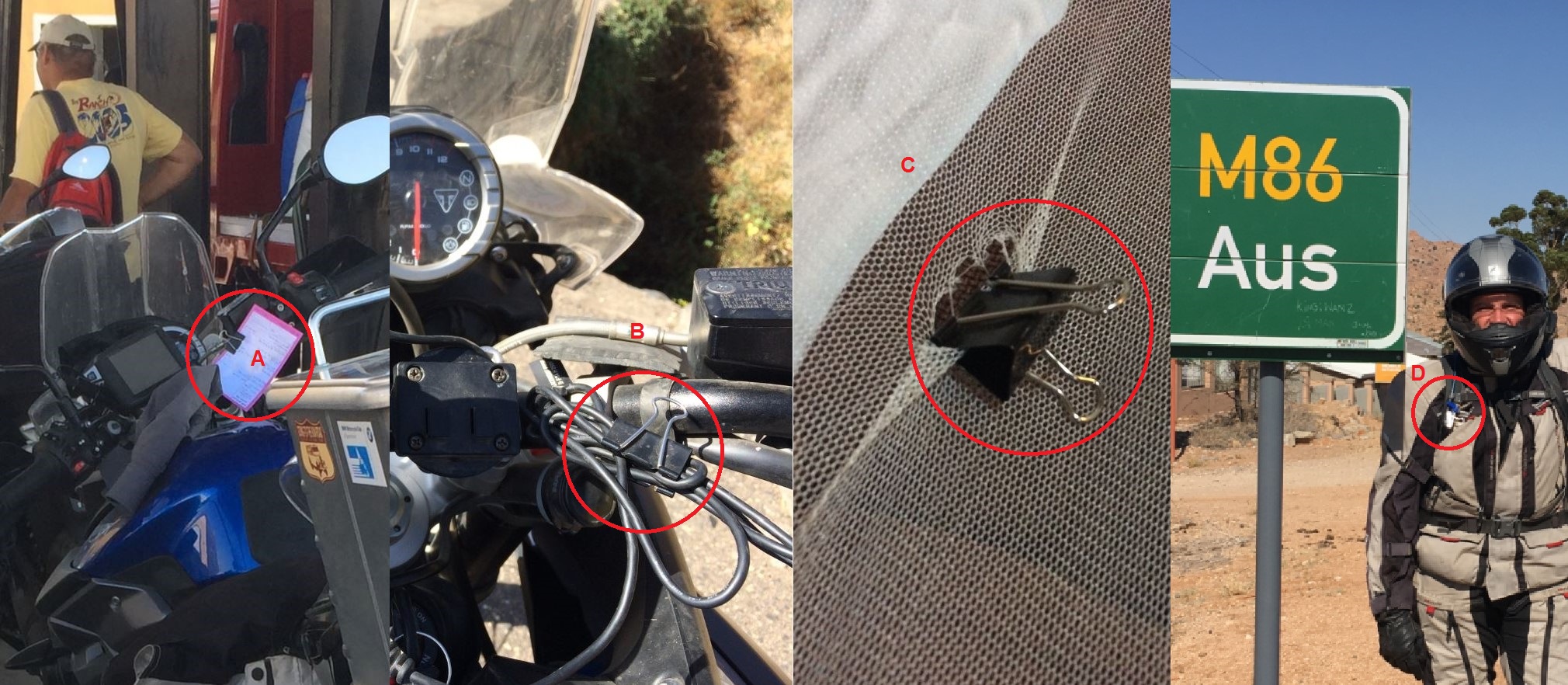
Handiest items? A friend told me how a set of bulldog clips once saved him in sub-equatorial Africa as he was able to clip together his mosquito net, which was apparently more holy than Our Lady of Fatima. So ten or so of different sizes were taken along just in case. One was mounted to the handlebars, incredibly useful for toll tickets, park tickets, gate tickets, passport, and general border documentation when the gloves are on. Another was used to crimp the Camelbak hose following the mysterious loss of the bite valve somewhere in Ethiopia. And finally, a few actually were used on a holey mosquito net in Malawi.
What else? For Africa, there are lots of opportunities to demonstrate how much your eyesight has failed as you have aged. The Serengeti was a squint-fest as we tried to spot whatever the hell the guide was wildly gesticulating at. A good pair of binoculars, 25x at least, is essential to calmly pull out of your bag, look intently in the direction the guide is pointing, and then put down while loudly saying “another one of Africa’s big five” and making a big tick flourish even though you didn’t actually see anything. Then patronisingly offering the binoculars generally to the rest of the group to make them regret they hadn’t thought to bring any. Even better, take a camera with a very impressive zoom, and take photos of whatever it is that no-one else can even see.
A lot of focus during the planning phase was placed on having a bottle opener. This may seem misguided to non-adventure riders, given that the number of times a bottle opener was required turned out to be nil. But then again, the number of times a tyre repair kit was required was nil, and the number of front brake levers needed was also nil. It is guaranteed that had we not had a bottle opener, cork would have been the only bottle plugging design throughout Africa, so we rest easy knowing we were prepared.
“I assume you had convenient luggage with multiple pockets?” asks the cat with a disinterested expression. Not really, the two Compass supplied Black Wolf 120 litre duffel bags were more than large enough, but were the Bermuda triangle for smalls, some of whom were packed neatly away in Sudan and re-discovered in Zimbabwe. Cindy was far better organised than my individual supermarket plastic bags with her zipped pack-away pod concept, each colour-coded for easy recognition and guaranteed to enforce clothing genre apartheid in the melting pot bag.
Motorcycle luggage tended to reflect old habits for the group rather than C2C necessity given that two full duffel bags were never that far behind. Some had a full hard pannier and top box set, one had that plus engine guard bags and tank bag, one a soft pannier and top box set, others just a top box, and one virtually nothing. Having some bike luggage is useful; the wet weather gear in the support vehicle 2 hours behind is bound to be a source of justified regret. Cindy and I had the solid top boxes, the idea was to have something secure to put the helmet in when we stopped at some African village populated with chickens looking for something to nest in.
As it turned out, the top box filled with all sorts of useful stuff including mini compressor, tyre repair kit, chain lube, disc lock, broken spokes, accidentally stolen hotel towels, and empty water bottles. Top box design is important because a flimsy one will crack up, surprisingly one of the smallest and most reputable Touratech aluminium top boxes didn’t stack up as the entire base cracked around the mountings, but it wasn’t its first trip. Cindy’s Hepco & Becker Gobi plastic box which is the cheapest top box per litre of capacity always bounces around like an ADHD child after a double espresso, but the mountings only came a bit loose once. My Hepco & Becker Alu Standard had a slightly bent base plate by the end, but otherwise no problems. The conclusion? Get proven and reputable luggage and attachments and avoid bike in-house gear (Yamaha and Kawasaki are not good apparently) or take it for a really rough test ride first, but soft or hard, size and materials are individual budget and choice factors.

Navigation assistance was a mandatory Compass directive, and not having it would mean total disaster if separated from the group, particularly when trying to find hotels in big cities. The Garmin 590LM GPS was great, but the best thing we did was take Cindy’s MacBook Air which had the Garmin Basecamp software on it with all our maps. Made it easy to see all the days and all the attractions down the length of Africa, and fix any dramas. Cindy’s cheap Garmin Etrex 20x probably wasn’t ideal, in terms of guiding the navigationally impaired it seemed more of an Irish Setter than a Labrador, and in hindsight we would have bitten the bullet and bought another 590LM or similar, as she needed to be kept close to avoid wandering off. With GPS’ there is always a risk of gross user errors, so buying one and mastering it well in advance is highly recommended.
Almost finally, what about riding gear? Perhaps naked envy of what others had is the best way to describe what I’d do differently to my value-for-money Dririder Adventure suit. Klim and BMW Rallye suits are great but require a bit of luck with Powerball or some other huge payout lottery. However, Africa C2C only starts at 31° north and finishes at 34° south, so cold and raining typically can only occur at high altitude in the Simien Mountains in Ethiopia and in Kenya, and at the end in very southern RSA. Vast majority of days were spent overheating and humid, and as per SE Queensland rain events were more likely to be short and sharp rather than all day drizzle. So cool and well-vented gear was ideal, and having a wet weather onesie that could be quickly jumped into to keep the whole package dry was likely the best solution for those who didn’t want to just get wet and SE QLD blow dry. Would have been perfect over the Dririder.
The Sena 20S dual Bluetooth communicators never failed us and were mainly used by me for listening to music, and Cindy for listening to “music”.

And finally, a discussion on expedition motorcycling would be a complete waste of time without some unasked for opinions on dual sport tyres, so anyone with a life can stop reading now.
We took our standard and reliable Metzeler Karoo 3’s off before the trip at 10,000km, did 7,200km on Heidenau Scout K60’s until Nairobi, then over 10,000km on Mitas E-07’s which have life left as they chug slowly home in the good ship Wide Bravo on hopefully calm seas. Rode all brands on and through gravel, sand, mud, and dry and wet bitumen, but the Mitas E-07’s probably had the toughest life.
The life ranking (longest to shortest) is Heidenau, Mitas, then Metzeler. Noise when the doof-doof music was off for some reason (loudest to quietest) is Metzeler just over Heidenau, then Mitas. Off-road ranking (best to worst) is pretty much indistinguishable, I can’t pick any difference and subtle tread pattern nuance typically isn’t the difference between life and death for our sort of riding. On-road ranking is similar in dry conditions given that our cornering isn’t exactly Jorge Lorenzo, but in wet conditions it seems to be (most to least scary) really worn Metzeler, Heidenau, Metzeler, and Mitas. So depending on how the worn Mitas E-07’s go for the return to the daily commuting adventure after the glorious re-union occurs, I think they might now be the favourite.
But several more years of trials on continental motorcycle expeditions is required to confirm.
 travellingbennetts