The crossing into Ethiopia on day 15 was trouble free, with an official at the immigration office taking no more than 5 minutes to check our passports, take our fingerprints, ask some standard questions, and release us into the care of customs. Very similar process to the USA, except for the lack of uniforms. Customs was effective but not very efficient, as the electronic gadgetry of the immigration office had maxed out the border-crossing post budget; we were back to carbon paper and triplicate forms, the time-warp confirmed by the Happy New Year 2009 poster on the wall. Several hours of hanging about ensued, watching the hordes of people walking through the border with no apparent controls.
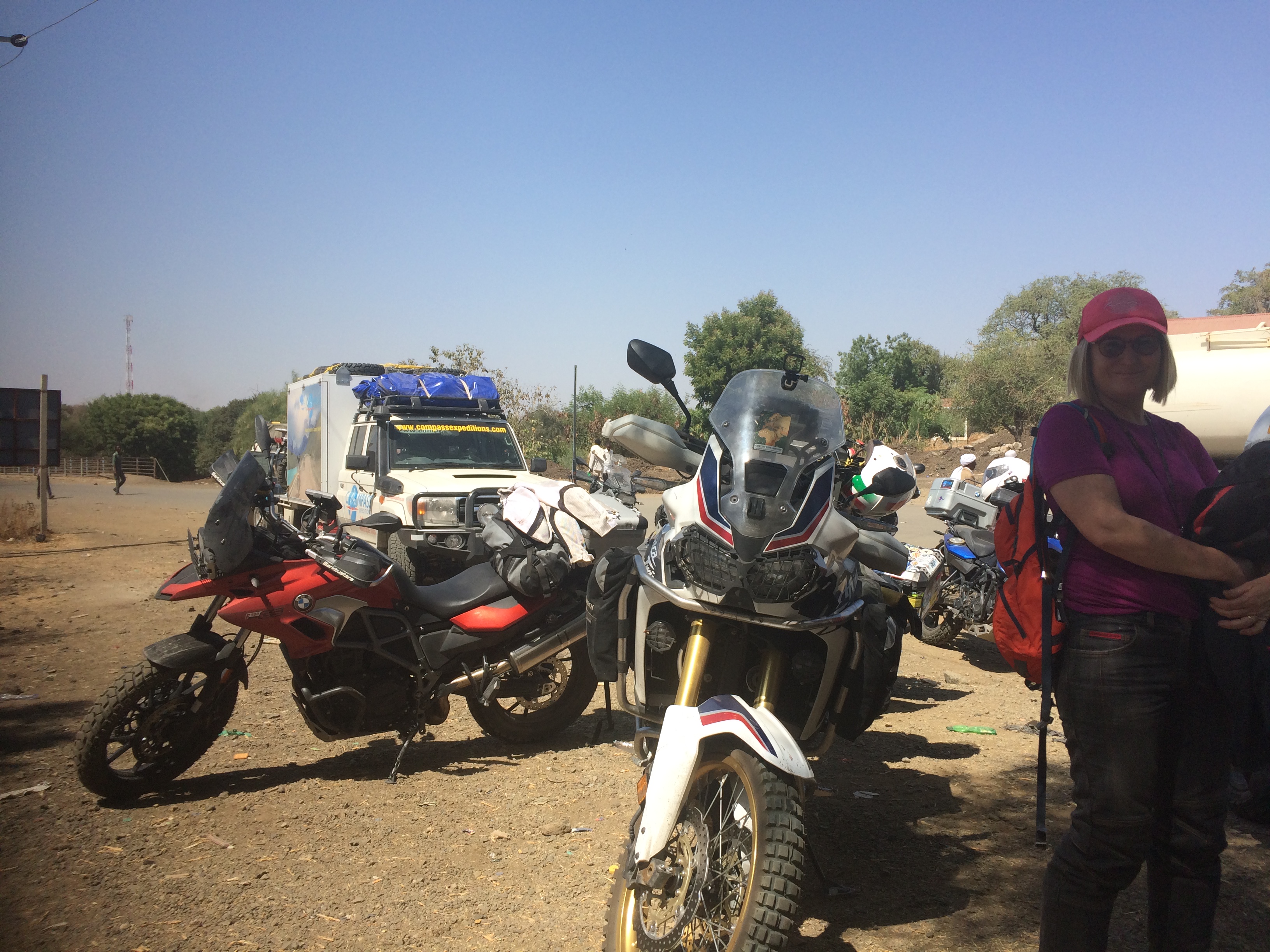
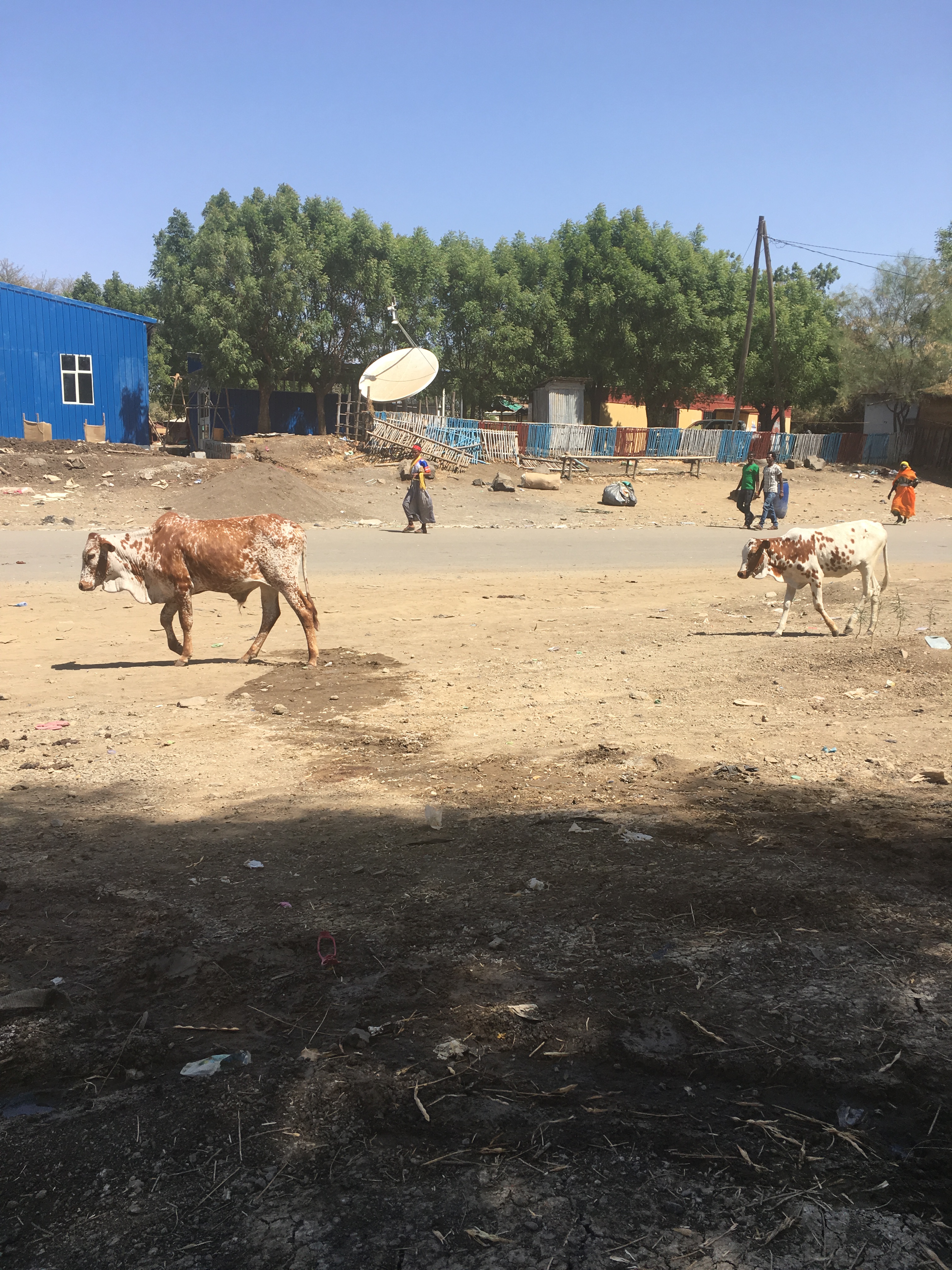
Ethiopia is a country with a population of 90 million people, and all but one of them is out on the combo road/footpath network (the President has official engagements which prevents him blindly strolling along and across busy thoroughfares). There are three main categories of road user – firstly the pedestrian, often accompanied by goats/sheep/cattle/donkeys, secondly the vehicle user which is mainly restricted to tuk-tuks, trucks, passenger buses, or donkey carts, and thirdly unaccompanied stock. Normal cars are quite rare except in major cities, with the result that petrol can be quite hard to come by but diesel is everywhere.

So keeping the pace up is a relative term, even out in the open country averaging over 70kmh is doing well, with constant changes in speed required based on the density of completely uncaring pedestrians and stock. Villages are utter bedlam, looking before crossing the road is considered unnecessary detail. So with finding petrol becoming a problem, we staggered into Gondor after dark, which did have the advantage of reducing the road user numbers slightly.
And finally, we were back into the world of real beer, with the excellent Ethiopian brewers fondly appreciated. Wine is developing, but several good drops were quickly found and destroyed over a light dinner before bed. Ethiopia is famous as the origin of coffee so of course this was sampled and determined that strength was typically a 9 on a 10 point scale, so a compromise of half coffee and half hot milk was adopted by Cindy at the breakfast buffets.
Day 16 was a relatively short riding day, with the trip up to Debark used to calibrate the senses and learn to control the streams of abuse fired at sheep who suddenly decide that the grass must be greener on the other side of the road, then change their small minds three times rapidly. It was also our first exposure to an Ethiopian road traveller phenomenon – the Chucker. With a genesis during the famines of the 1980’s when aid groups would distribute food to villages, a culture of begging and expecting handouts from complete strangers has arisen. In the same way as feeding wild animals will change their behavior to ultimately become aggressive, the same has occurred with many people in Ethiopia and we can probably blame Bob Geldof and Live Aid.
Anything unusual passing such as motorcycles larger than 125cc starts with hands out, normally led by teen boys to the first of the riding group, then with nothing forthcoming, picking up rocks, sticks, and even bicycle tyres and cow poo to throw at following group members. Ethiopians are exceptional runners, luckily they are pretty poor throws but some direct hits were suffered to body and feelings of fair play.
Once into the insanity of Debark town we bought our Simien Mountains National Park tickets and did the off-road section up to the Simien Mountains Lodge, perched at 3,200m atop the spectacular volcanic range. The arrival coincided with lunch, then an optional walk to see the Gelada (bleeding heart) baboons or a trip to a waterfall. Cindy and Canadian Terry and I decided on the walk escorted by a knowledgeable guide and a security consultant with an ancient Hungarian rifle, and within ten minutes we were amongst a large group of the baboons, which are not true baboons and so are not aggressive and even allowed us to wander in amongst them.

Having spent a fair time engaging with the grass-eating baboons which operate in family groups ruled by a dominant male who relies on popularity with his ladies for his success, a bit like a bank manager, we moved to the precipice of the volcanic range. Long-gone glaciers have cut the range, with shear cliffs dropping hundreds of metres into gorges and canyons extending kilometres into the lower areas. Mountain sheep and ibex inhabit the area, but unfortunately our Outlook schedules hadn’t aligned with theirs presumably due to poor wireless connectivity and the difficulty hooved animals have using Apple products.

After taking in the incredible views and ignoring Africa’s highest souvenir sellers met on the track, it was the brutal slog back uphill in the thin atmosphere to the lodge, just beating a rain shower that turned into small hail while we were sitting in Africa’s highest bar recovering from the activity with a few beers.

Day 17 dawned clear and bright and with some relief that the overnight rain would dampen down the dust on the ride down the 18km of variable quality gravel back down to Debark. After lugging the gear to the support vehicle in the 15%O2 atmosphere, and eventual recovery, we successfully negotiated the gravel and arrived in Debark (pronounced Debacle) unscathed.
Arriving on market Saturday morning, thousands of people/animals/vehicles were all trying to occupy the same space simultaneously, surely in breach of one of Newton’s laws, making maneuvering the bikes through the throng quite challenging. A short ride on good quality bitumen was soon followed by around 50km of descent on reasonable quality gravel with some of the most incredible scenery of the trip as we descended from the Simien Mountains plateau into the valleys. After about an hour and a half of this we finally reached the base of the valley with the mercury climbing up around 30 and motiving the opening of the numerous zips on the gear.

After lunch at a spot on a road that would make sports bike riders openly weep with envy, we continued towards Axum. As the day warmed to past the mid-30’s Cindy had an eventful afternoon of having a bicycle tyre thrown at her which narrowly missed, she got stung by a bee on the neck with a resultant roadside first-aid stop required to remove the sting. She completed the afternoon with a bird kamikazing into her bike screen, no damage to the armour plated BMW though.

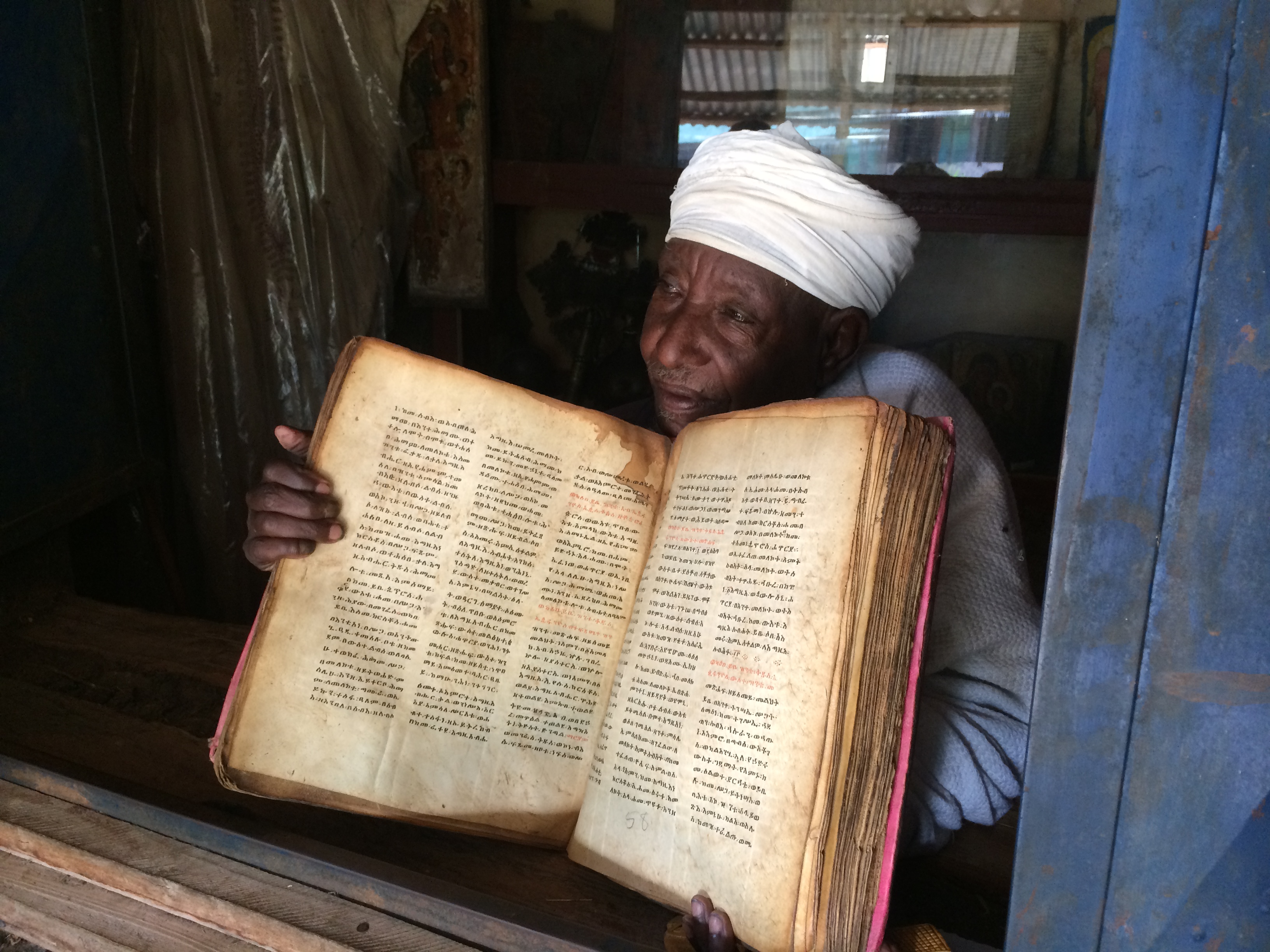
Arriving in Axum to a pleasant well-positioned hotel on the main street at a reasonable hour ensured that a casual stroll could be enjoyed. Axum is famous for the Lady Mary of Zion church that holds the Ark of the Covenant, however as tourists are not allowed in the church we just took their word for it while wondering why Steven Spielberg didn’t just have Harrison Ford stay a few days in Axum in Raiders of the Lost Ark. After finally getting to an elusive ATM that was way harder to find than any biblical relics, we finished the evening with a nice dinner in the hotel.
The following morning the sight of Lycra clad cyclists having a race around the main streets was certainly unexpected, although none looked to be typical of the Australian Mamils and were certainly more adept at maneuvering the peloton around loose stock. Apparently cycling is a growing sport in Ethiopia, and although lacking the ridiculously expensive gear, with their genetic advantages in long distance running the world might see some champions soon.

As a Sunday, Day 18 was less frenetic and the cattle/goat/sheep and donkey herders observed a days rest from their toils and were instead dressed in their Sunday best and seemed more inclined to lazily socialise around the town and churches and the same was to be witnessed at all the villages we passed through today. Even the rock chuckers seemed to have Sundays as a rostered day off.
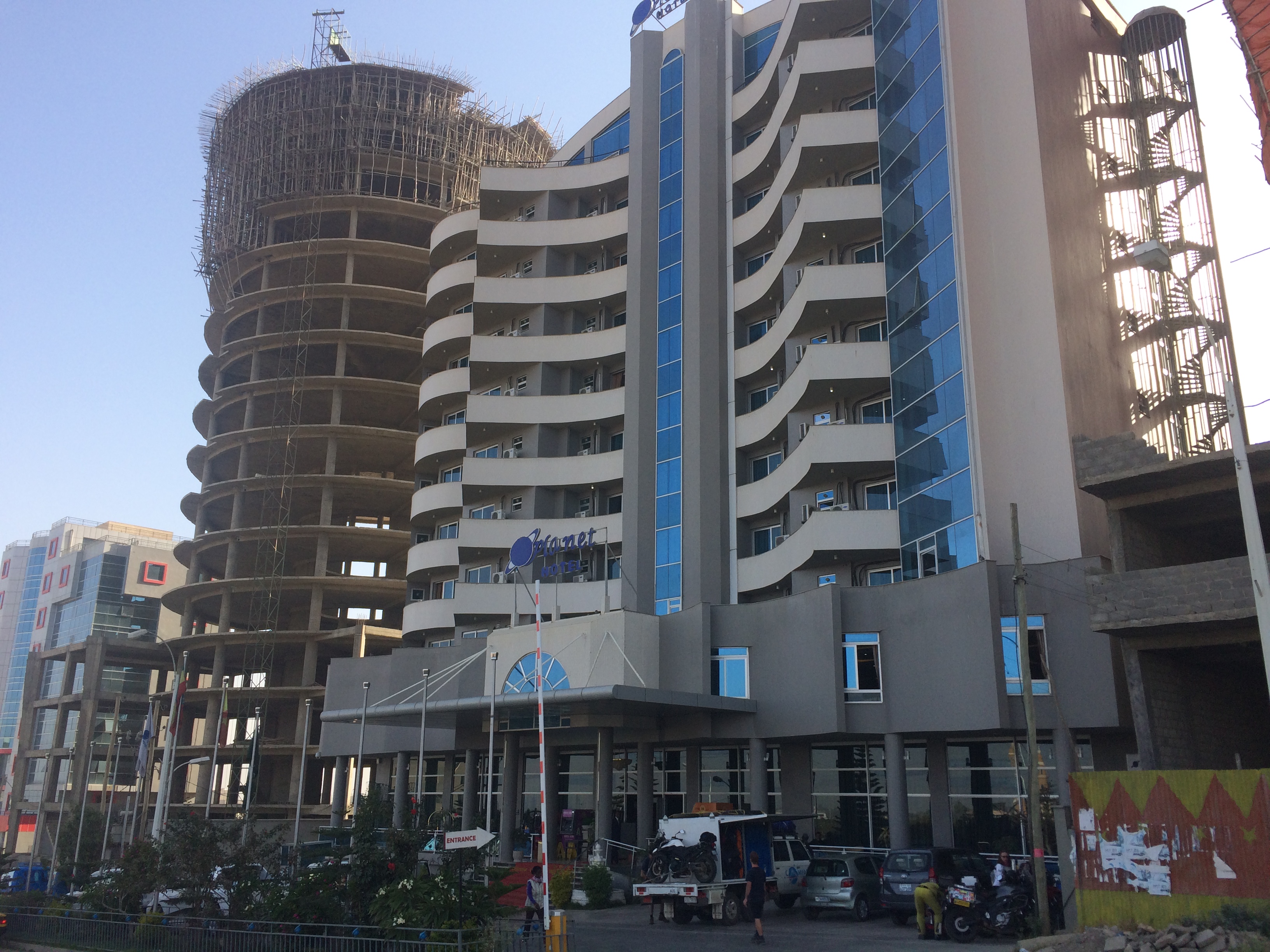
The ride was approximately 250km to the industrial town of Mekele, some good roads again with sweeping twisties to keep it interesting. Mekele is a large town of around 200,000 people and quite close to the Eritrean border region. Our destination was the Planet Hotel, which was very luxurious and the room size was bigger than any Ethiopian houses we had seen. This presented a good opportunity to get the laundry done, with no security clearance required for lady smalls as in Sudan.
Day 19 was a ride from Mekele heading south to Woldiya was around 270km and the morning started out briskly and then cooled even more while climbing the mountain range to about 14 degrees. The road was in quite a bad state of repair making progress quite slow. Lunch was one of our first crowd attraction events, with the standard operating procedure of the locals being to firstly run from anywhere within a two kilometre radius, then gather in a silent crowd while intently watching the foreigners tuck into a big Compass lunch with all the trimmings. Woldiya is a fairly small industrial type of town up in some attractive hill country, our cabins at the back of the hotel were very pleasant with coffee bushes in the front.

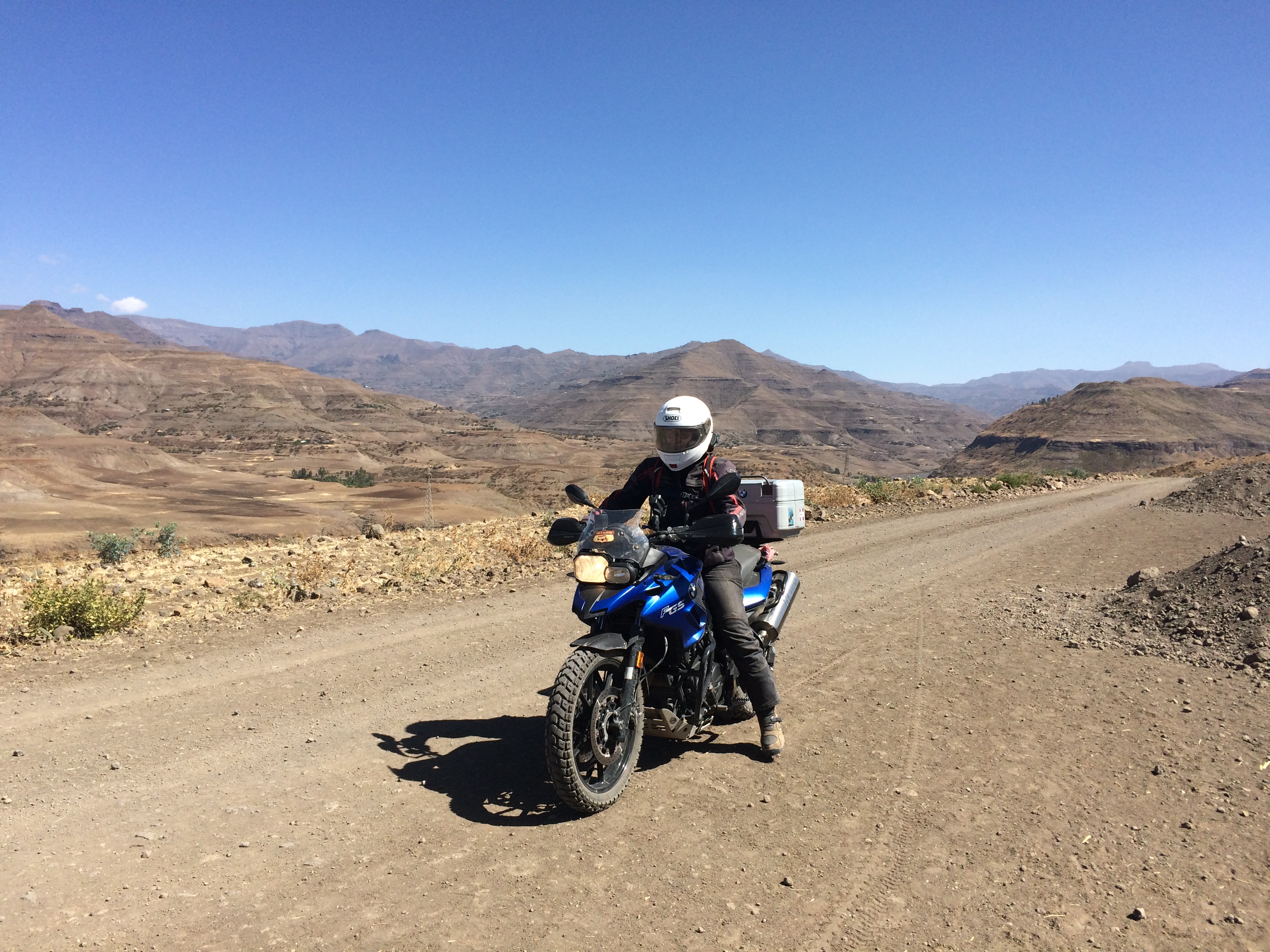
Day 20 will live on in infamy for Cindy as a major hiccup in the trip. The previous night there was vigorous debate about which road to take to Lalibela, a sealed road is being constructed but it is 60km longer than the gravel option and apparently had 40km of gravel anyway – so the tour leaders decided we would take the 105km original road with about 50km of gravel. The road started out quite well as smooth farm roads but soon deteriorated into steep switchbacks with large boulders and nasty washouts. Cindy’s first minor drama occurred on the wrong side of the road to descend into a gully, with a slow tip over the result. A group of 3 primary school girls helped her pick it up as a local bus had come up behind her, and the possibility of pens and money make an irresistible attraction.
Once the nasties were negotiated, a few minutes were spent in the increasing heat repairing the barkbuster hand grip that had come out of alignment as a result of the minor drop. With about 30km to go to Lalibela there was a deep washout in the middle of the road on which Cindy used more throttle than was needed to get up and over. Subsequently a steep drop off to the side she was heading towards at speed became the focus, which led her to turn sharply to the right and tip the bike over on her right ankle which was twisted and briefly caught under the bike. Luckily the support vehicle was close behind and she was quickly loaded into the vehicle for the trip into Lalibela.
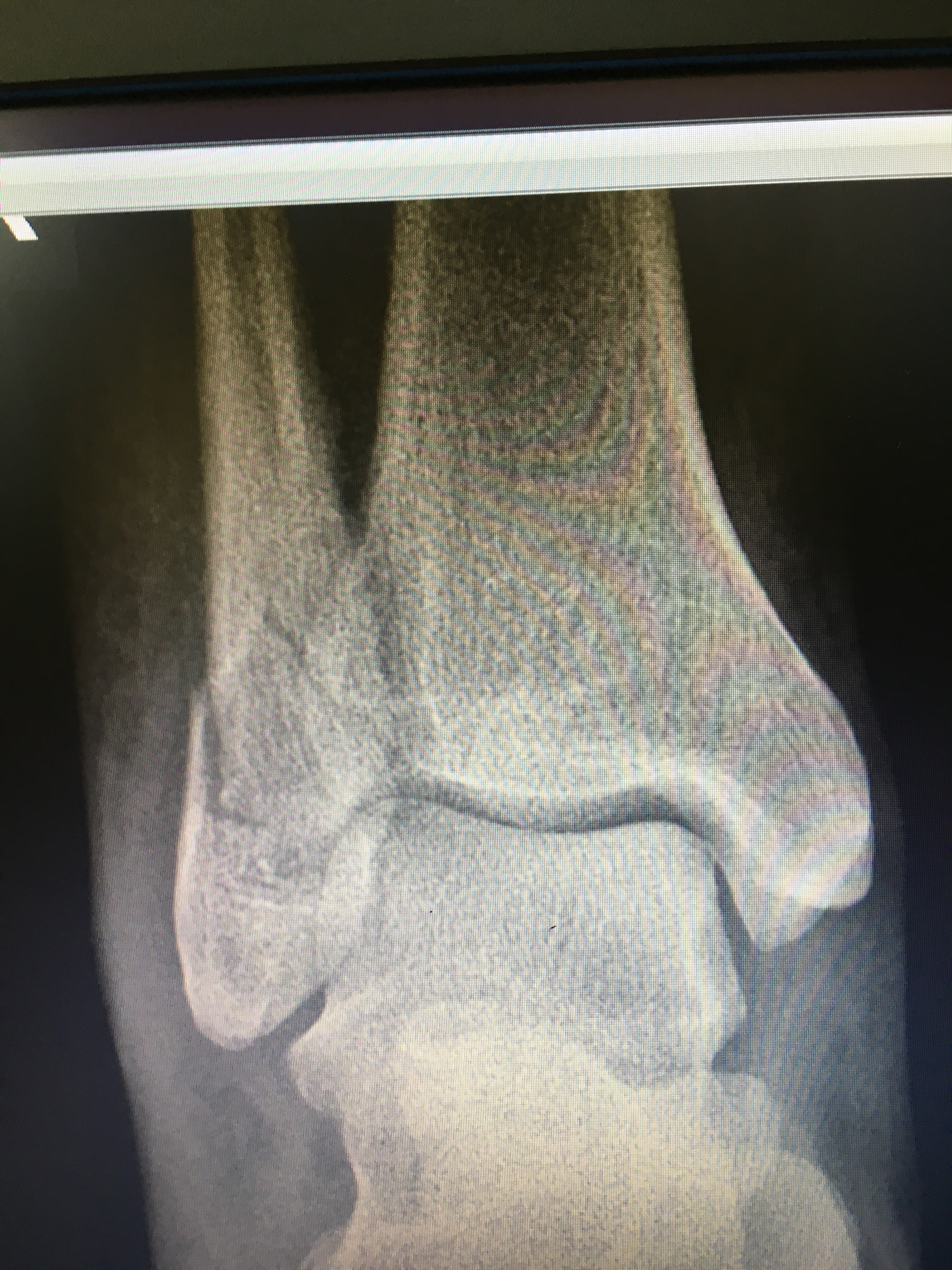
A trip to the Lalibela Hospital was arranged where we were told there may or may not be an x-ray machine which may or may not work. Eleven white coated professionals surrounded us at the Hospital in a tiny room and after some poking and prodding an x-ray was ordered which showed a fractured right fibula but luckily not displaced. A full leg rather agricultural cast was applied, but it did the trick and stabilized the ankle. No crutches were to be had which did make us wonder what the locals do.
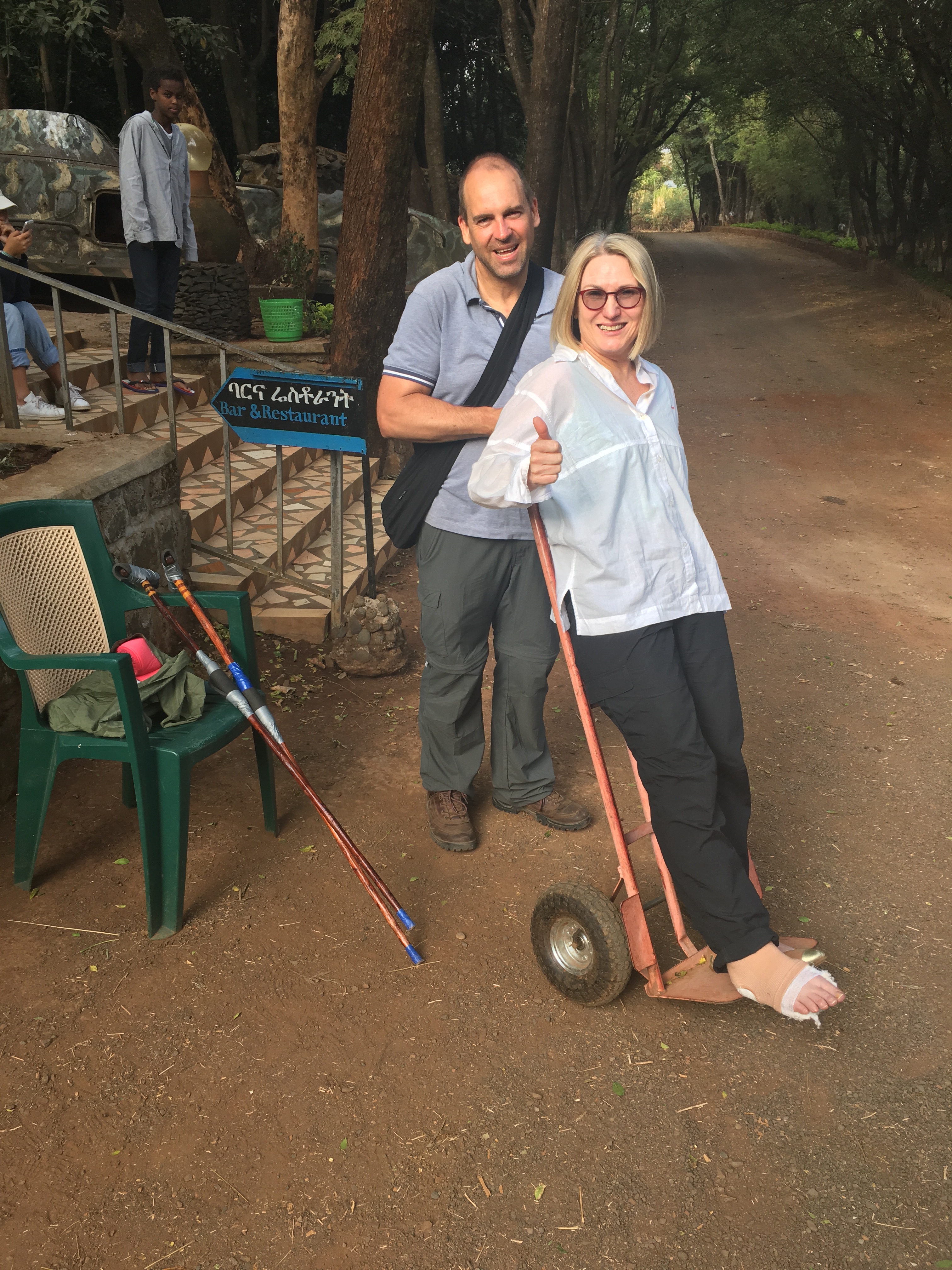
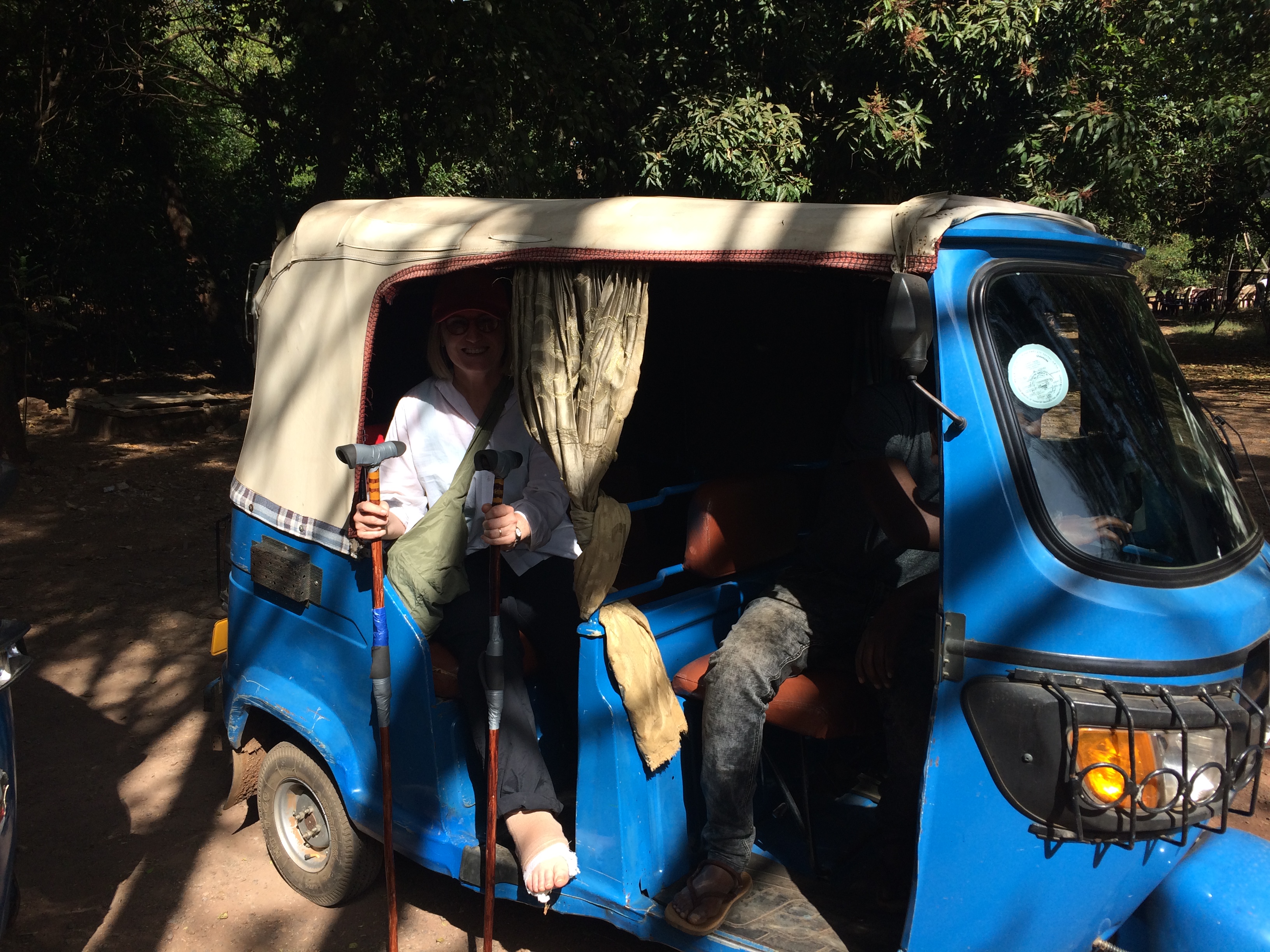
Very tall sticks used by church goers to support themselves during the very long services were purchased from the market and after some modification with duct tape and the padded hip liners from Cindy’s bike pants she was more or less mobile. An upside was that we had 2 days in Lalibela so there was time to get the equipment and get mentally across the backward step. Suffice to say there were tears and disappointment, but after a night pondering all options, it was decided for Cindy to ride in the support vehicle with Brendan and her bike on the back until further professional advice could be obtained on the ankle, four days away in Addis Ababa.
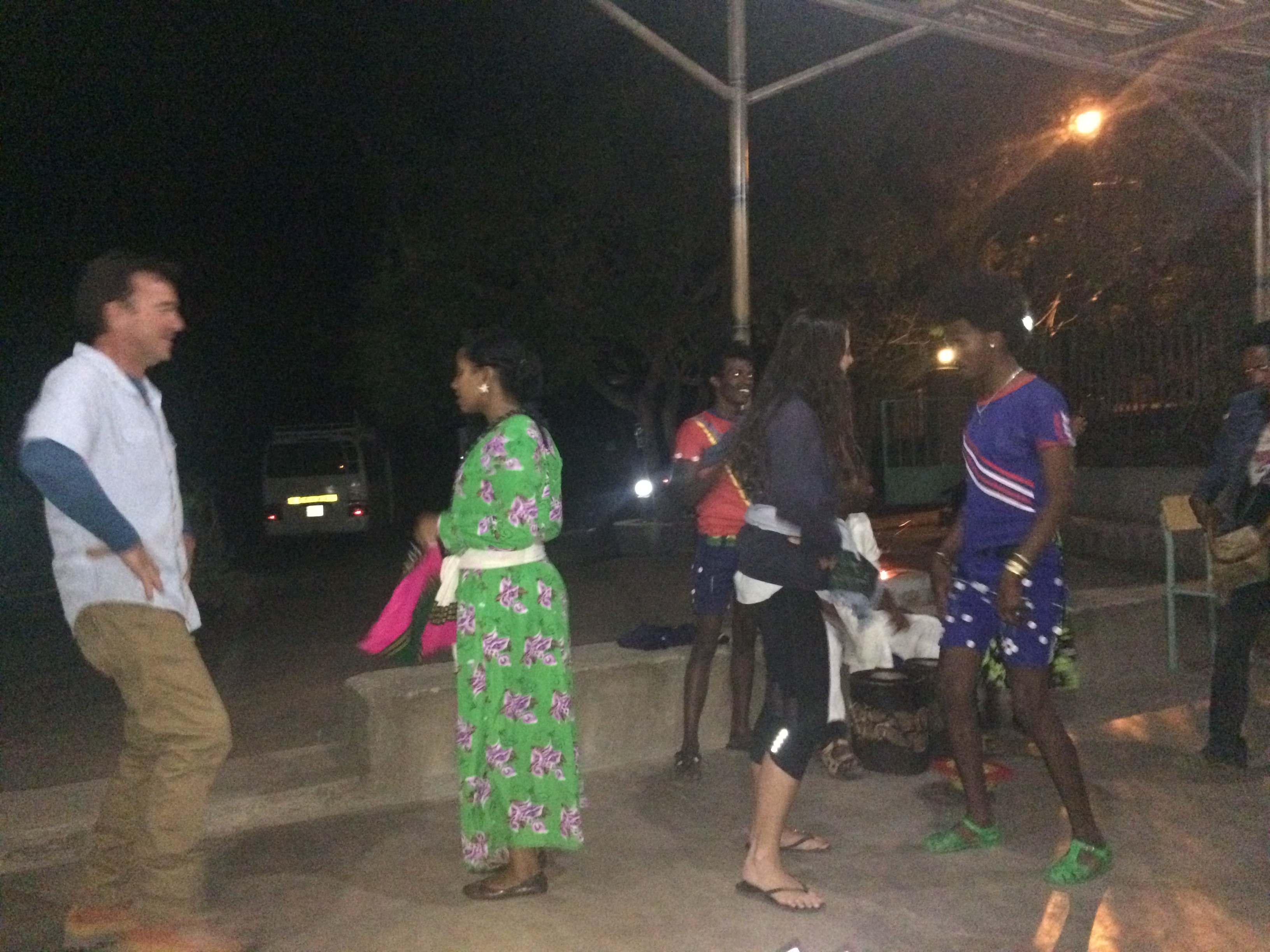
That night we had a fun display of traditional dancing and a coffee ceremony at the Hotel, although by the time the dancing was done everyone had forgotten about coffee.
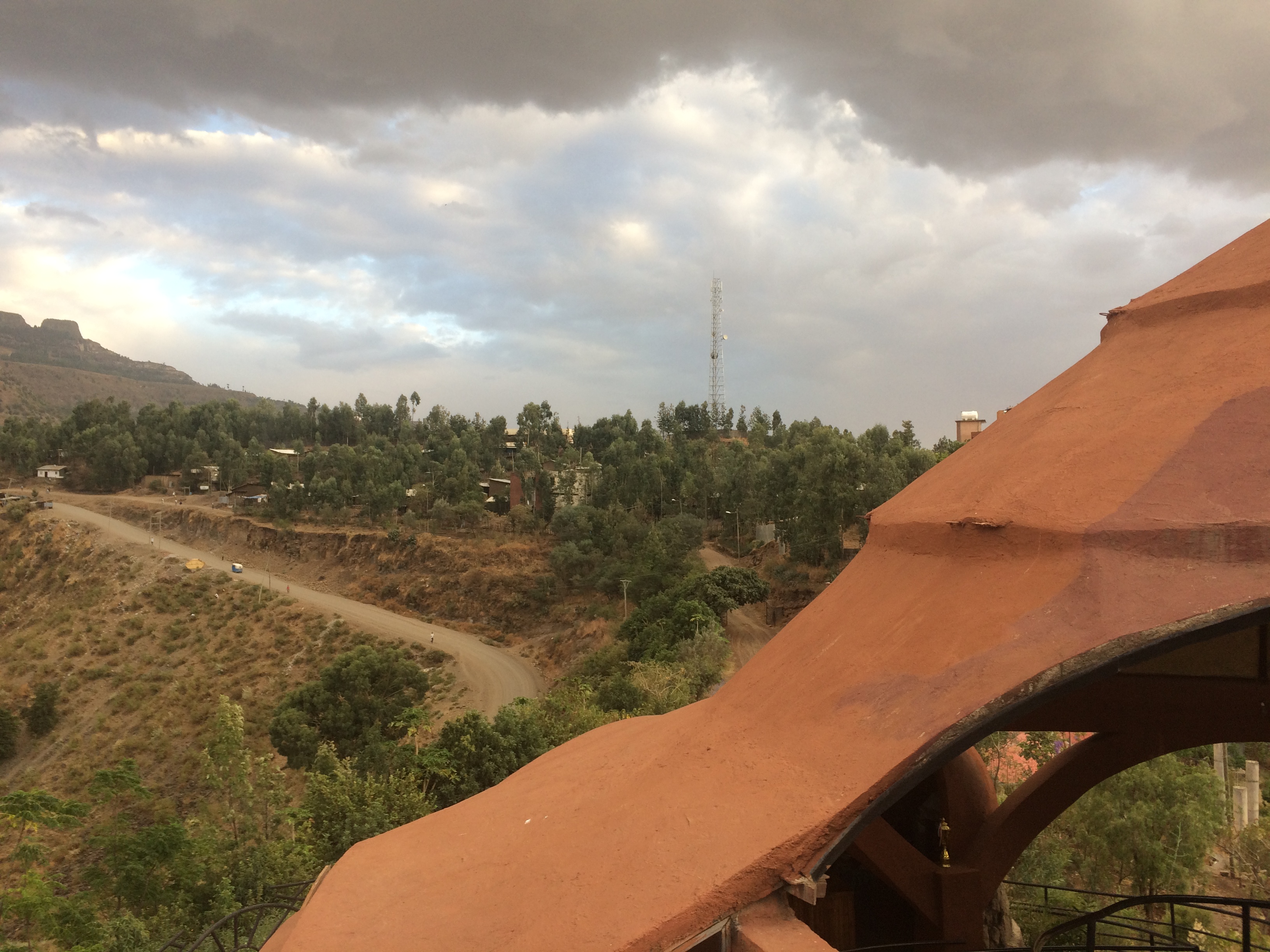
Day 21 was a sightseeing day in Lalibela with its 11 churches carved into the ground out of granite in the 13th century by King Lalibela to create a new Christian pilgrimage site due to Jerusalem being under Muslim control. At popular Christian festival times it is apparently hectic with the devout. Cindy preparation went on, an eminent orthopaedic surgeon suggested we should reduce the leg cast to below the knee, or at least he would have if he wasn’t imaginary and we had asked, so we did it anyway which made life very much easier. Dinner that night was at a restaurant run by a Scottish lady, the food and views were excellent, at least until the thunderstorm hit which prompted a young and fit staff member to pick Cindy up and carry her downstairs while the diners helped by carrying their drinks.
Day 22 was Cindy in the support vehicle watching while the riders did 60km of horrendous and dusty road works, before about 250km of reasonable road through the eucalypt forests that have provided regrowth in a land devastated by goats.

Scenery was less spectacular than previous days, but the landscape was now becoming quite tropical with papaya and pineapple sellers lining the road to try to make an unlikely transaction with someone going past at 75kmh. Fuel was difficult to find, none was found by several of the group before we reached the destination of Bahir Dar.
We arrived at the very pleasant Abay Minch lodge resort, me last for some reason which may have been related to the GPS. This was the first Cindy movement trial, with Craig and Kathy’s room commandeered because it was a lot closer to reception. A box trolley was successfully trialed to get Cindy close enough to the bar to get drinks and food, a very cost effective wheelchair and it even would allow strapping the load in on more advanced models.
Day 23 commenced with a boat cruise on the enormous but shallow Lake Tana, which is the source of the Blue Nile. Hippo virginity was lost in the very start of the river, with three specimens observed happily wallowing close to the edge. Noted early with hippo watching was the captain’s hesitance to get within about 20 metres, and his rapid deployment of reverse whenever one disappeared under the water. As Africa’s most well-known and notorious killer, no-one in the boat was begging to get closer to satisfy the demands of their iPhone camera. A quick trip to a 12th century church complete with a museum we were not allowed to enter, and we were back at the lodge for lunch, an aborted attempt at finding fuel, and the 260km afternoon pedestrian-avoiding ride to Debre Markos.
Debre Markos was reasonably uneventful, except for Cindy who was faced with a room on the first floor and a lift that was out of order. A few beers and dinner within the confines of the hotel and we were back to dreaming about roads free of suicidal stock and tuk-tuks.
Day 24 was a ride from Debre Markos to Addis Ababa. On the plateau north of the Blue Nile Valley, the agricultural regions came into view, with much of the area north of Addis Ababa given to grain growing. The harvesting is mainly third world method, with the stalks cut, piled into big neat heaps, and then old and young required to load as much as possible and walk to the threshing area.
Threshing is via walking donkeys around in the piles, then using the wind to separate grain and chaff, with the final step using a soft broom to get rid of the remaining husks and chaff. Incredibly labour intensive, but Ethiopia has a lot of labour.

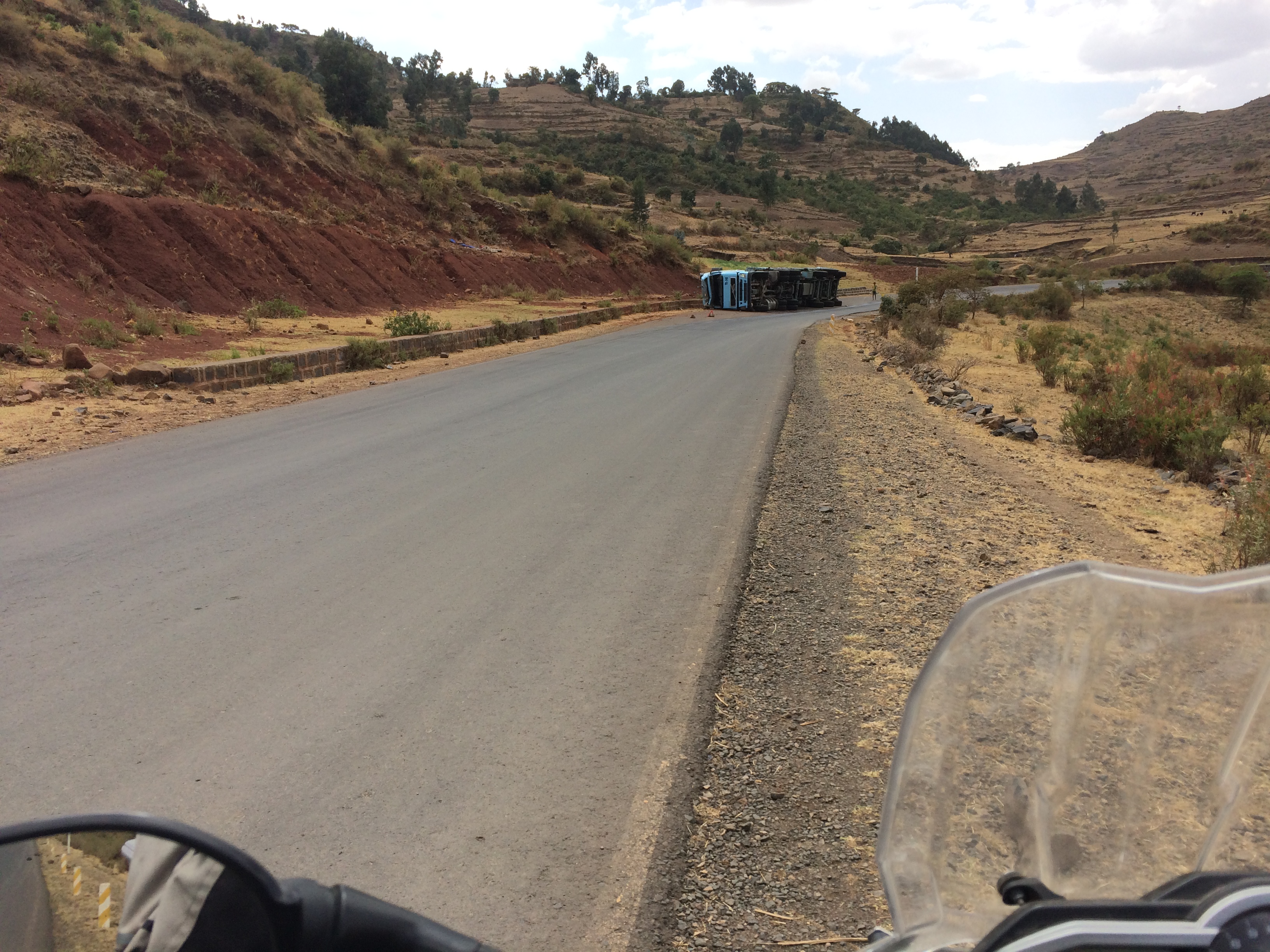
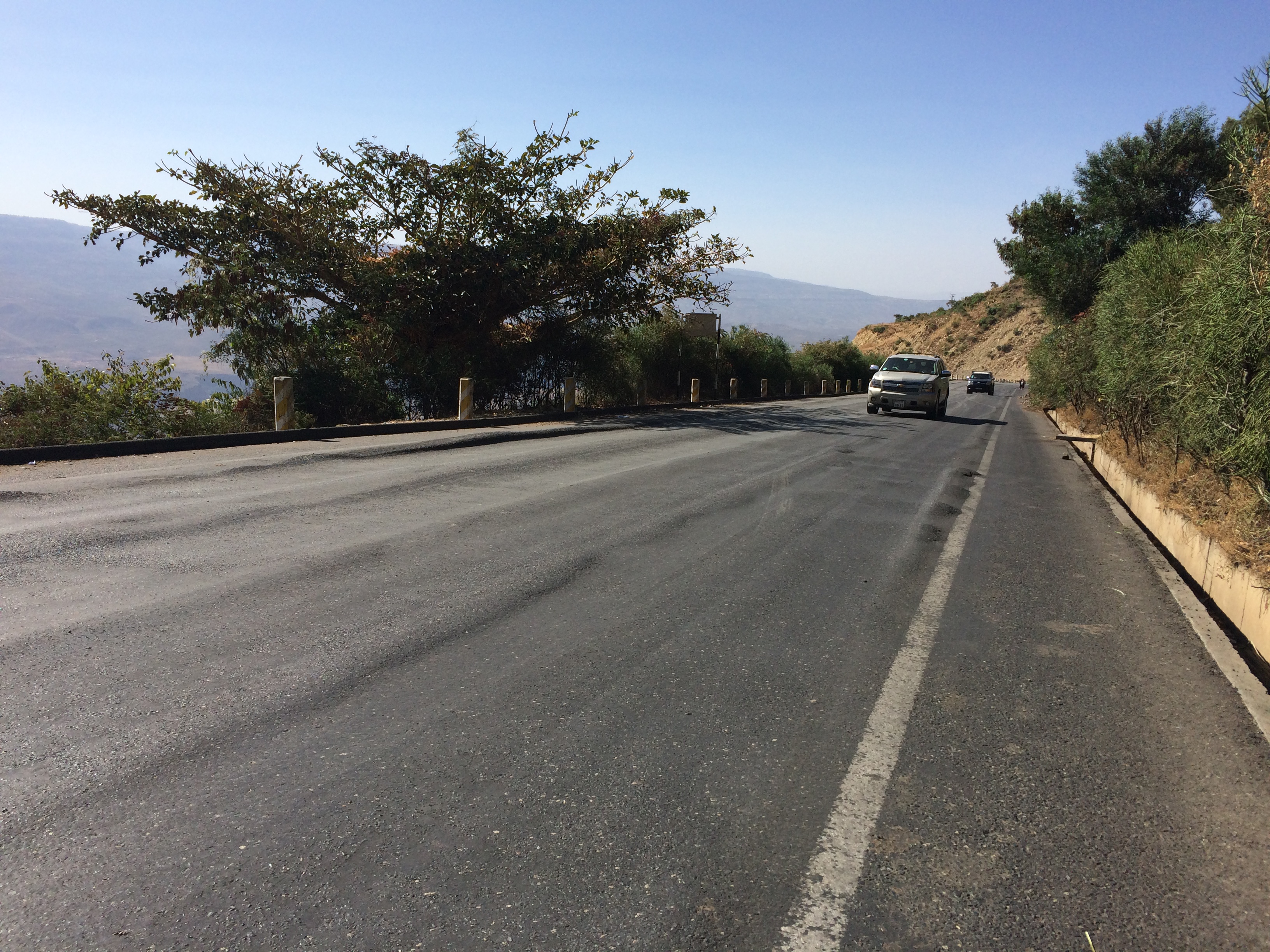
The highlight of this leg was the journey through the Blue Nile valley, with a serious descent followed by a serious ascent. The road condition was atrocious, with huge drops and potholes, plus bitumen ruts, caused by the bitumen melting on hot days and trucks creating furrows. Accidents are common, with a purple onion truck roll-over providing a reminder of the true cost of wanting a nice bruschetta lunch.
A big drop and a pot hole on the descent caused serious concern for the front rim, so a stop on the road was required to check out the rim and spokes, fortunately all OK. After restart, something brushing on my leg was initially ignored, then with horror realised that it was the GPS power cable trialing behind the bike and there was no GPS mounted to the dash. A stop, then a pulling in of the cable like a fisherman expecting an empty hook rather than a world record Blue Marlin, but amazingly the GPS was still attached and with joy re-mounted. It didn’t seem to care and continued to navigate as though nothing had happened.

The Blue Nile valley is truly spectacular, carved through the rock and reminiscent of the Colorado River Canyon. Not that I had time to look for long as I was trying to ensure the GPS couldn’t come off again, and baboons were getting worryingly close. Baboons look innocuous, but memory of National Geographic photos of their teeth had me back on and riding quickly.
A bit further on a nice lunch spot was located, with me, Adrian and Alma, and ride supremo Andrew settling down to wait for the support vehicle for lunch. We waited. And waited. Then we wandered about and waited some more. Eventually, Brendan and Cindy rolled in with details of an incident on the road – a young girl minding cattle was pushing a cow across the road, and as the vehicle went around behind it a calf ran under it and was struck.

As per tradition in Ethiopia, a large crowd started to gather quickly, compensation was offered to the hysterical girl’s grandmother, but was refused and police were called. A car with men who spoke good English suggested immediate fleeing of the scene and not to stop for anything, which was considered good advice. However, even in the subsistence third world everyone has a phone, so police in the next village stopped the vehicle. The driver is always guilty, so Brendan was told to get in a police car and return, however this would have left Cindy in a situation like being in the middle of a hostile MCG on grand final day, so they both returned to the scene in the vehicle.
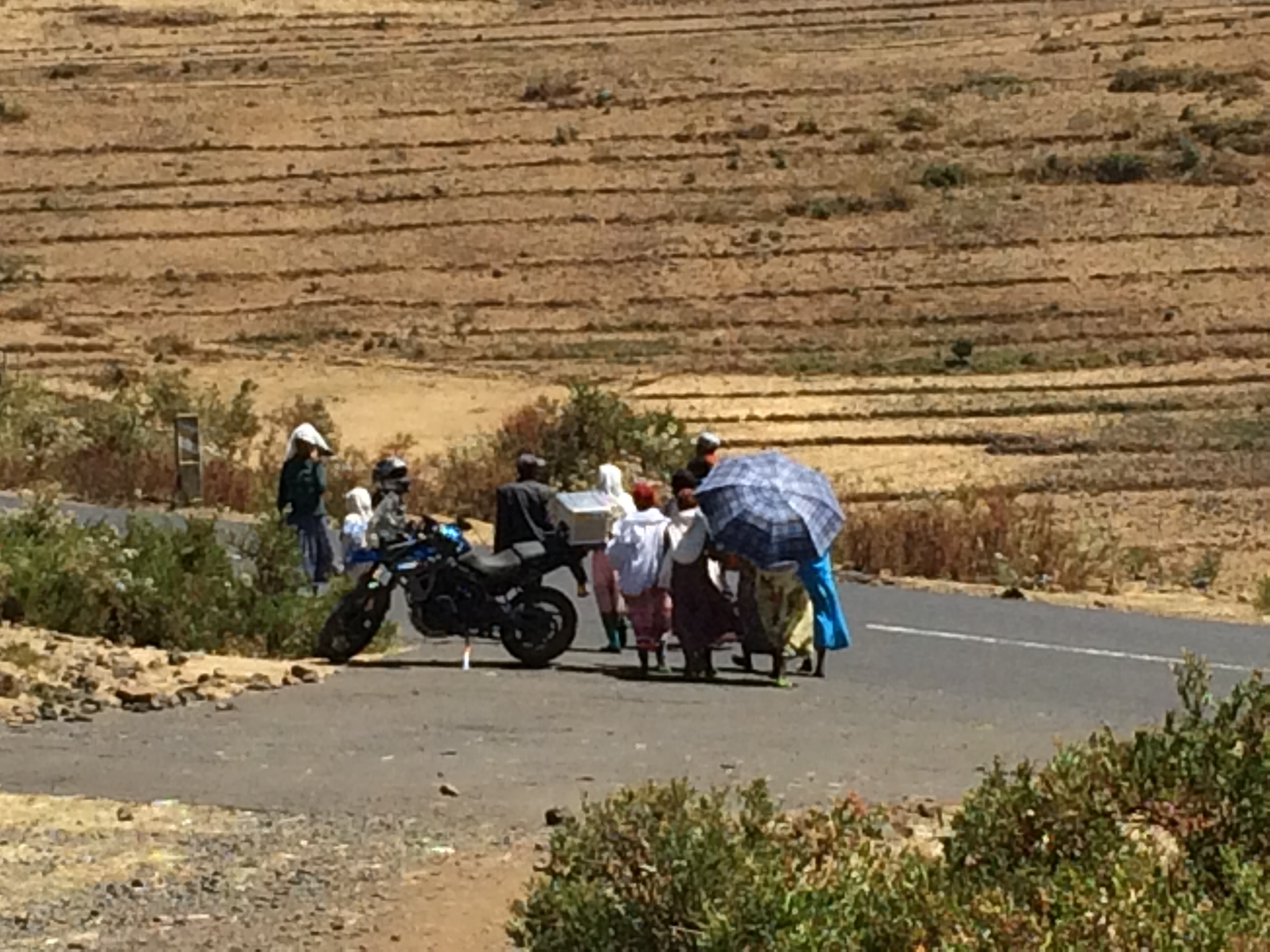
After negotiation, compensation was eventually agreed, paid, and the journey continued. By the time they arrived at the lunch spot, our secluded scene had attracted the usual crowd of rural villagers playing at completely shameless beggars, but eventually we got going for the run into Addis Ababa. The traffic was not as bad as expected mainly because it was a Saturday, and the GPS performed beautifully allowing definite navigation. Until I got to where the GPS insisted Jupiters hotel was, while physical reality indicated it definitely was not. What looked like a botanical garden was where Jupiters was supposed to be, so I pulled around the corner into a quiet spot to figure it out.
While poking at the GPS in a caring and sensitive way, suddenly I was hit hard from behind on the back of the helmet. Luckily managing not to fall off, I turned to see a man dressed in defence force uniform gesticulating between streams of abuse and hits to me and kicks to the bike. I pulled my helmet off to hopefully diffuse the “masked man” worry, and said that I was simply looking for the Jupiters hotel. The man kindly responded by hitting me and knocking off the barely attached GPS, with a ludicrous situation developing with me trying to re-helmet, attach the GPS, re-glove, and him shouting and hitting. Eventually, with a final kick to the back of the bike I managed to get away. Luckily he must have been recognised by his superiors as a total boofhead as he didn’t seem to be allowed to carry a firearm.
Just down the road after I had stopped to sort out navigation before it got too messy, an opposite person appeared who was incredibly helpful and gave precise directions. It turned out that I’d stopped outside the Presidential Palace, and as it was a Saturday he must have been at home rather than out helping clog the roads.
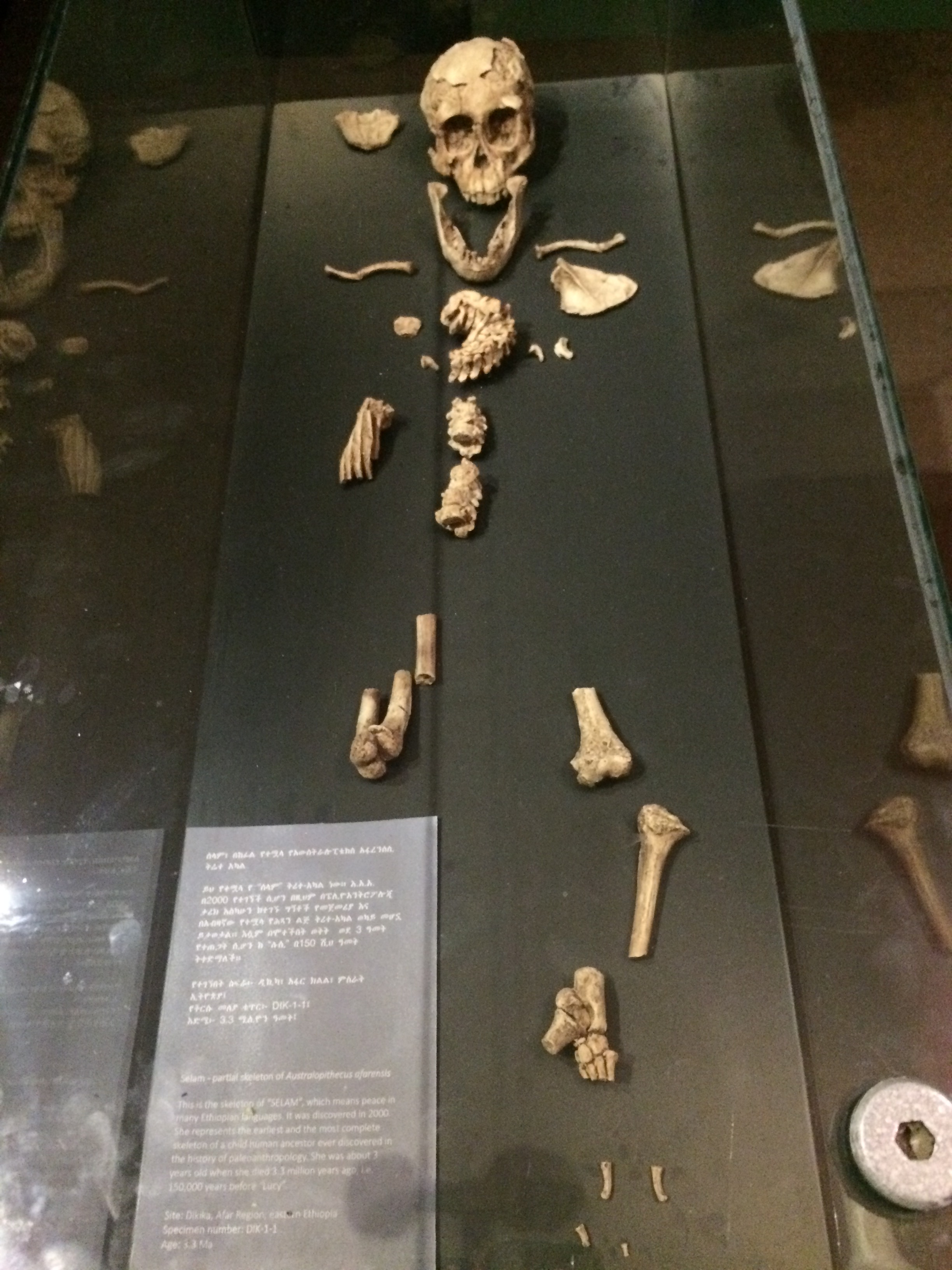
Addis Ababa Jupiters was great, with a wheelchair and helpful staff for Cindy, and a competent orthopaedic hospital on Day 25 to re-do the cast to something more shapely. A visit to the museum to see Lucy our 1-2M year old ancestor was mandatory, and the origin of humans is very well presented compared to the rest of the museum.
Day 26 was 320km from Addis Ababa to Yirga Alem, leaving Cindy in the safe hands of the Radisson hotel for a week to allow the fibula time to recuperate. The start was a really ugly run in early Monday peak hour traffic south on some good and some really ugly roads via agricultural areas and huge greenhouses. A nasty pothole was hit, resulting in a bent rim, and joy that the Tiger’s tubed tyres hold a major advantage for poor riders who hit things.
Lunch was probably our most awkward of the trip, on the side of the road amongst a huge crowd who mainly just stood and stared. Nothing like being the centre of attention. Arriving in Yirga Alem, I smashed a popularity PB when I pulled into the service station; within 30 seconds the crowd was 5 deep, and within a minute 10 deep around the bike, it was like I was selling front row Robbie Williams tickets for $1 each. The service station owner tried to clear them, but as it was a university town it was good that they had natural curiosity.
The lodge at Yirga Alem was great, besides the monkey who shamelessly watched me take my riding pants off through the bedroom window. Another coffee ceremony was attended, with probably the best coffee ever even though it took an hour to make, and we were treated to a viewing of vultures and hyenas feeding before getting off to bed to rest for the last full day in Ethiopia.

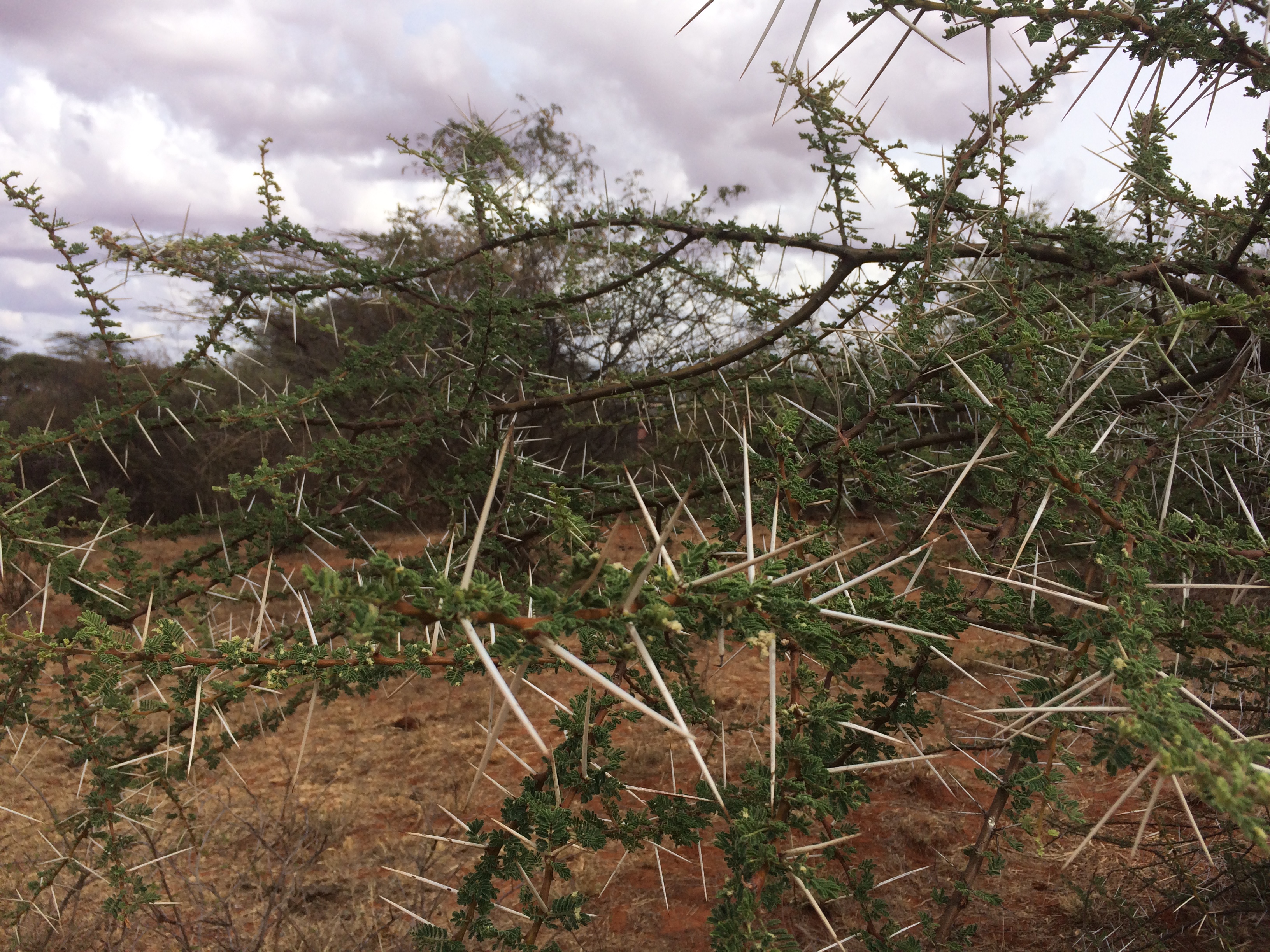
Day 27 showed the changes in landscape to perfection again, starting in the tropics at Yirga Alem and finishing in the country around Yabello that looks like the tropical Northern Territory; those who have been around Katherine will have a good impression of what it looks like. Except for the trees, which are universally spiky and nasty. Another thing that changed was the road quality, with the first 150km brutal road works, ranging from a short section of incredibly slippery red clay which brought about one rider’s downfall, to very rough and quite technical, to smooth and fast. Eventually the roadworks ceased, and we were up to speeds previously only dreamed about in the reducing population, albeit with some dedicated villagers still taking their valuable time to wander across with stock or beg and stand staring at any stopped riders.
The termite mounds are in attendance, but these termites seem to go for height rather than mass. Some reach up to 9m in height, and the shape seems to suggest that the Ethiopian termites are compensating for something.

We pulled into Yabello for fuel lunch-less as Andrew had stopped and been missed by the following rider, with the result that everyone just kept going expecting to see a bike at a lunch spot appear. After fuelling up, the GPS said that the Borana Lodge was a bit further along toward the border, but on arrival the Lodge was claimed to be in the middle of nowhere and the middle of the road. Tentatively pushing on another 200m, a sign indicated we were in the right place, but a really rough bush track into the lodge had the doubt-o-meter well into the red. Why on earth would anyone build a lodge out here? Luckily there had been a reason, as we found the lodge and the pioneering riders loitering in the canteen.
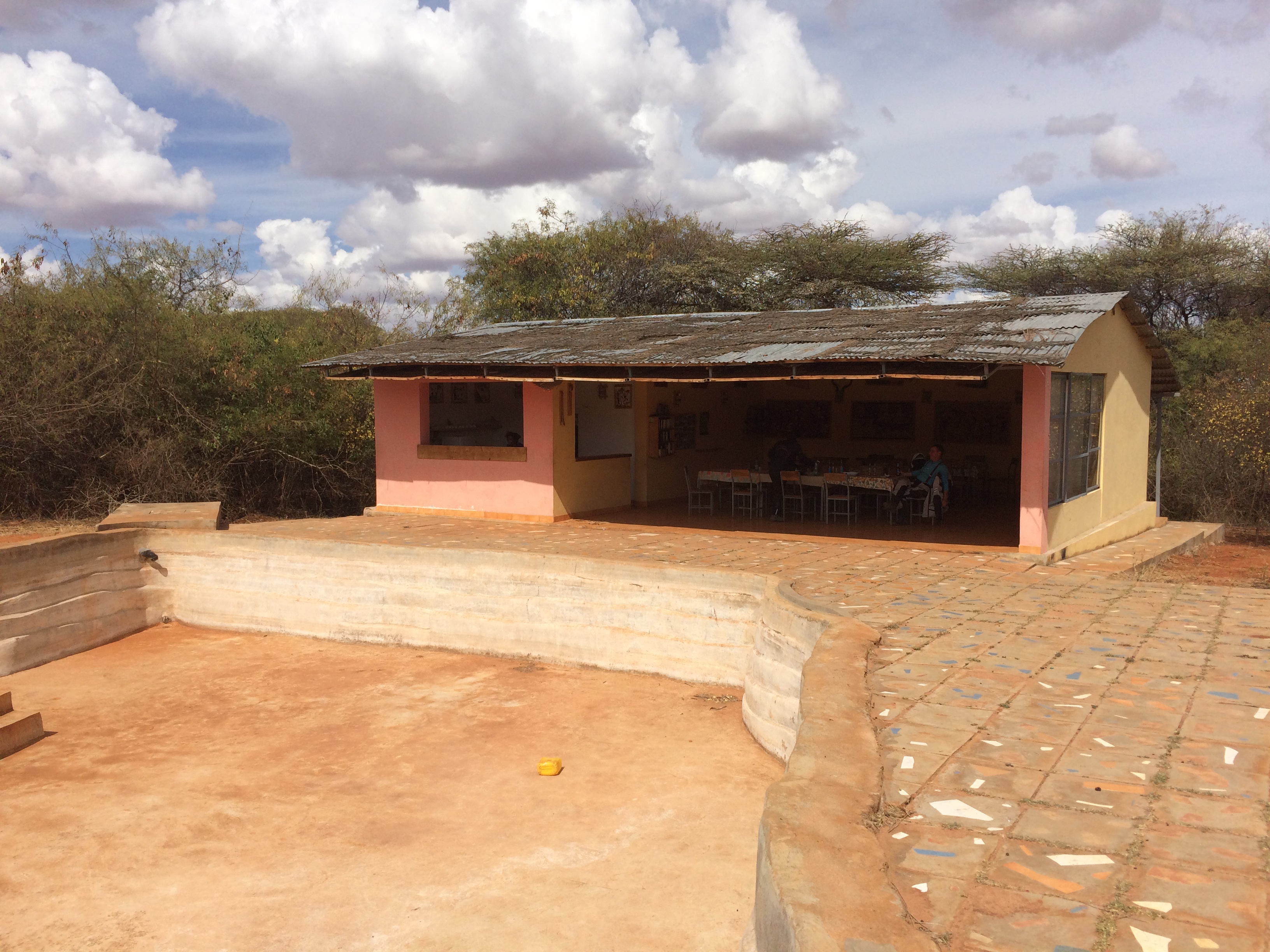
The lodge is on the edge of a wildlife sanctuary with loads of birds, and is only “manned” when there is a booking, so things were in the process of preparation, however a spaghetti bolognaise lunch begged from the staff was voted best lunch so far. The rooms were good, fairly Spartan but plenty of space and some lucky people had water, and the elite even had hot water. A very nice dinner with tepid beers saw out the last full day in Ethiopia.
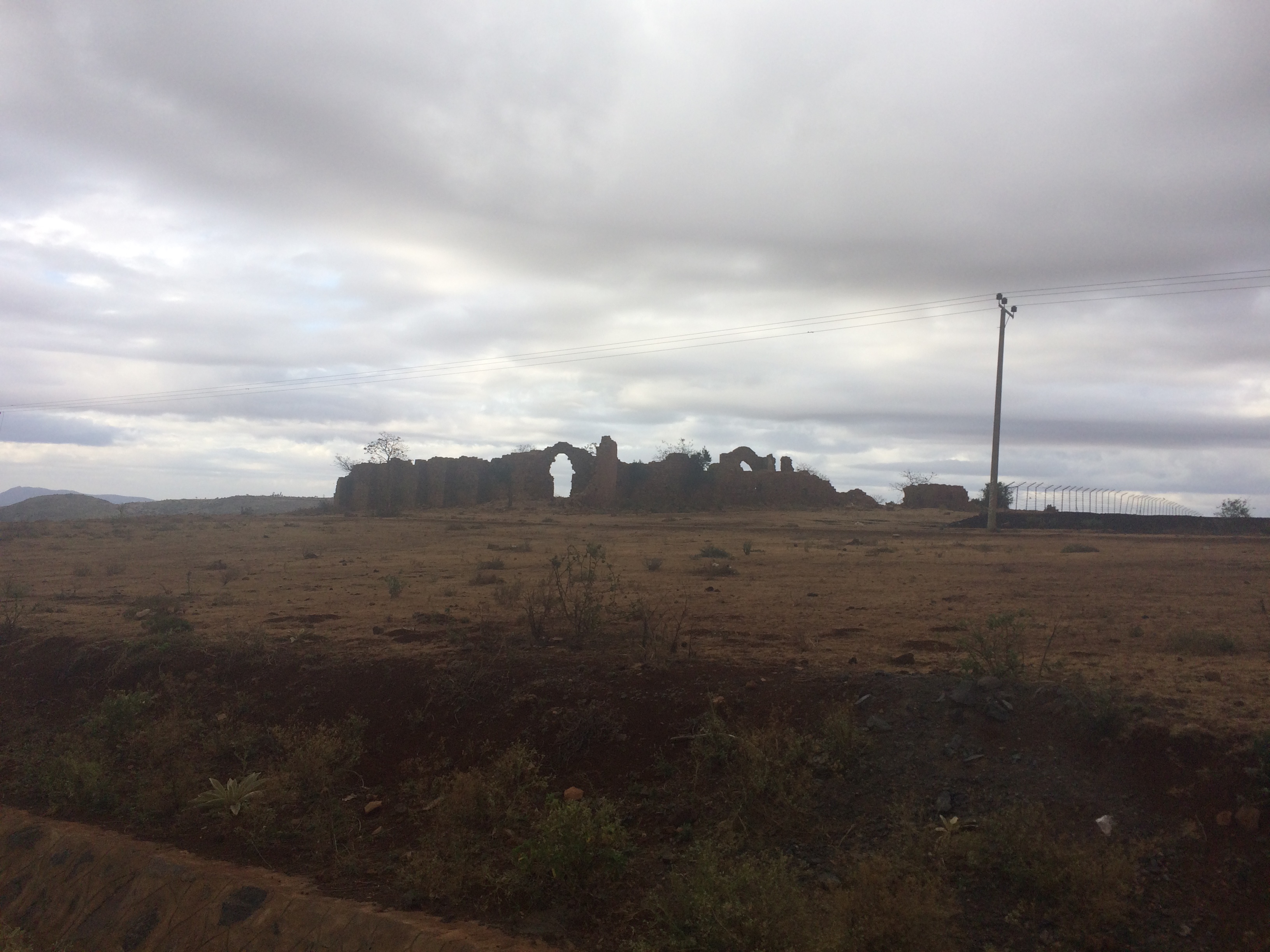
Day 28 was border day. It kicked off with a 200km ride on very good roads down through the surprisingly small town of Mega, before the border town of Moyale, which unusually seems to be on both sides. Leaving Ethiopia had similarities with exiting Sudan, with random moves up and down the road, parking in places that looked anything but official, but this time complete with crowds who somehow get involved in the process before being shooed off by officials, and then coming back again as soon as there is an opening.
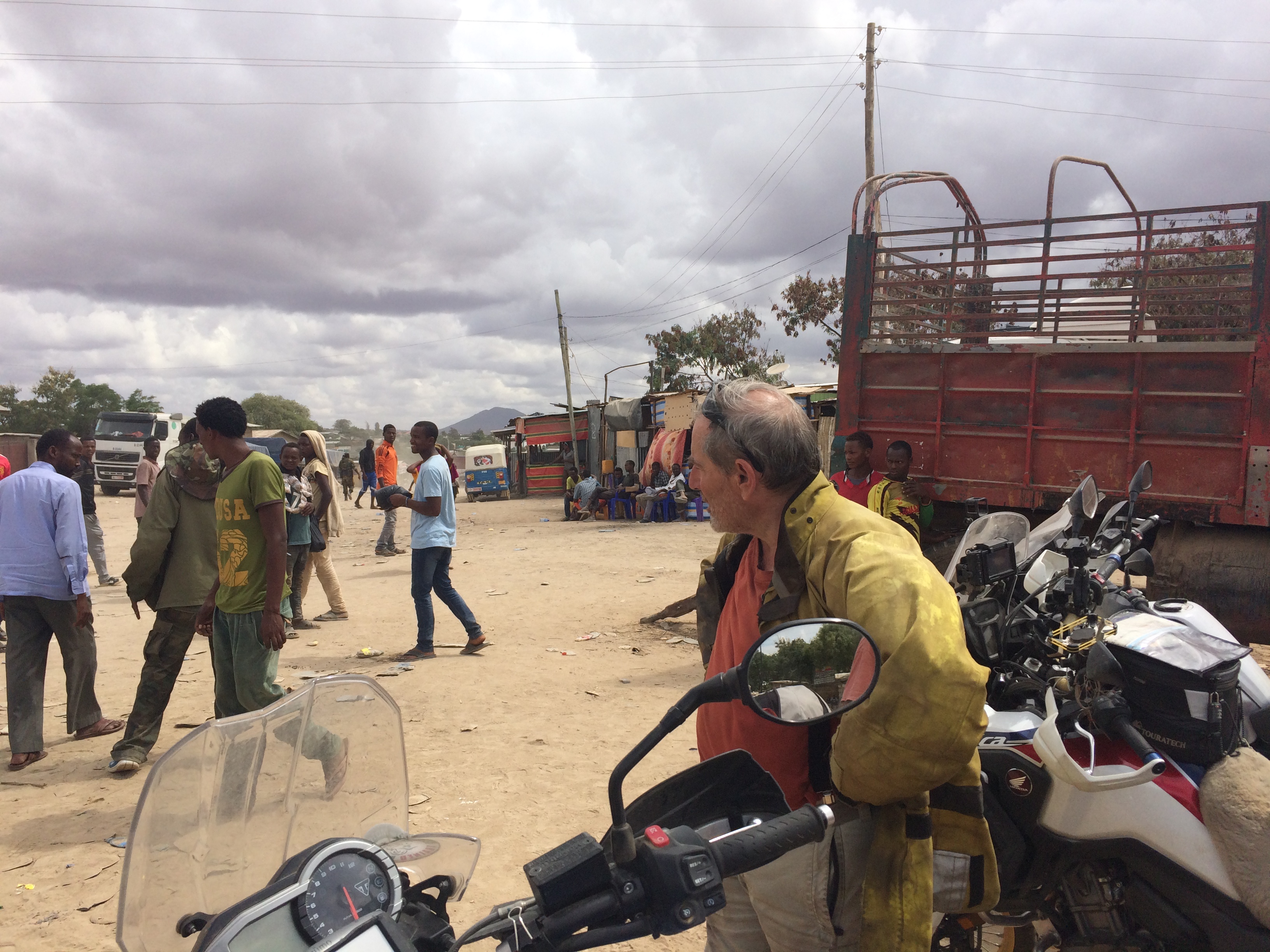
The process was quick though, even the carnets took only an hour so before lunch we were stamped, signed, mounted up, and riding through to the very flash looking border post in Kenya.
In summary, Ethiopia has some of the most amazing scenery in the world, lots of great and friendly people, interesting history, and great food, beer, and wine. The quality of accommodation was surprisingly high, and the Planet Hotel now holds the record for the largest non-Presidential Suite room in the Duncan world. On the other side, the crowds on the roads and the begging culture are really negative, one memorable occasion by the side of the road summed the culture up; although you are a complete stranger, you are white and therefore rich, we are poor, therefore you have to give us a gift. From a riding perspective, we weren’t terribly disappointed to be leaving as the constant risk of things wandering onto the road and being at fault in an accident is very wearing, particularly in the southern part of the country. However, the northern part of the country has what must be some of the world’s greatest riding; hour after hour of deserted winding and good quality roads through spectacular mountains and valleys.
Three down; eight to go.
 travellingbennetts
So sorry to read of Cindy’s mishap. Sending positive spirits her way. (Note for the record: Suddenly, she’s making the most hardcore adventure crossing down the continent of anyone!)
LikeLike
Thanks Craig. We’ve got Terry with us, a north of Edmonton farmer and a great bloke so you are represented. He rides a 1200GSA, only 900km range poor chap. Cindy is back on, about to post the next chapter. Cheers Duncan
LikeLike
Hi Guys, great write up (as we have come to expect) but so sorry to hear about your little Woopsie Cindy. If anyone is to overcome such adversity early in the trip then it is you two. Remember Charlie Boorman doing something similar in the Dakar. You will find a way through and continue to enjoy yourselves. Sending you all of our positive vibes arhummmmmm (Guru speak for relax). Cheers T&J.
LikeLike